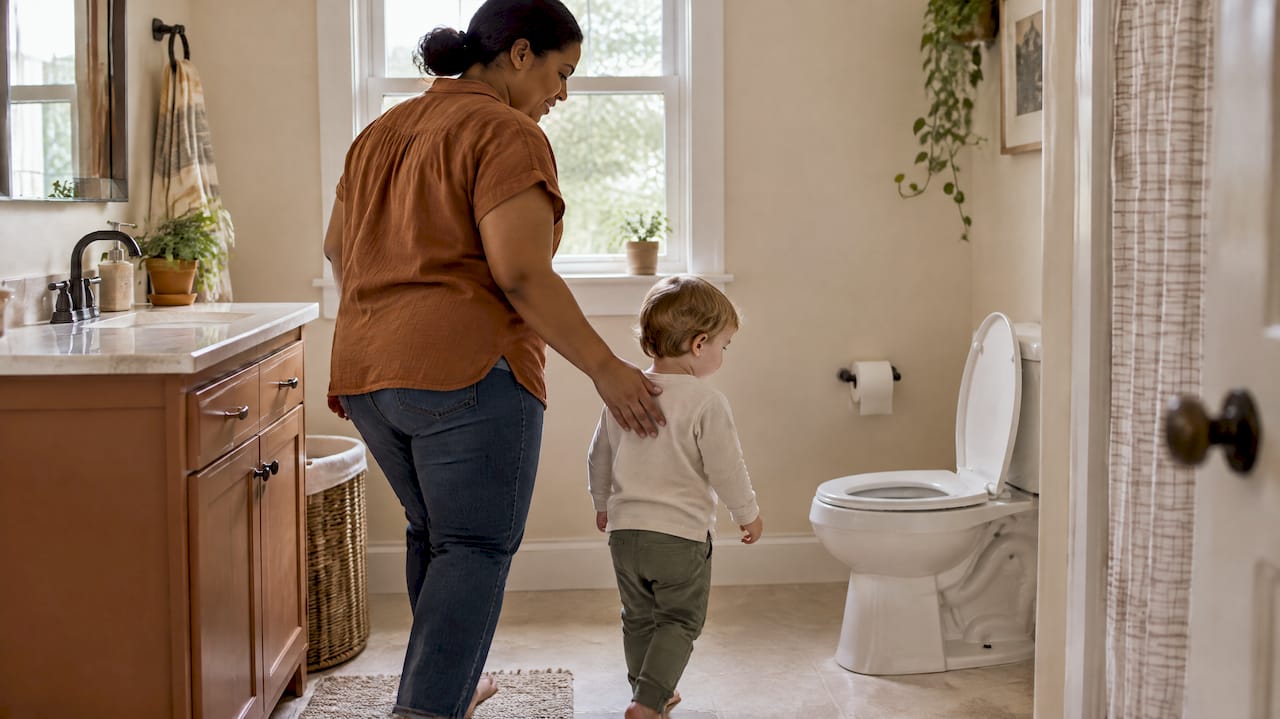
Puddles on the floor, wet underwear at the grocery store, a poop accident the day after a perfect streak. If this is your week, you are not doing anything wrong. Accidents are part of how toddlers learn, and the way you respond matters more than the accident itself: stay calm, keep the response short and neutral, clean up together, and go back to a steady routine. Many parents find it easier to keep that routine, and to spot patterns, when they log each day on paper in one place, which is what our Baby Bare Essentials planner is built for.
TL;DR
- Accidents are expected. HealthyChildren.org says daytime accidents can continue for months after training seems complete, even at ages 3 to 4.
- Respond calmly. No shaming, no punishment, no dirty-diaper “lessons.” Change your child, keep it matter-of-fact, and try again.
- A regular schedule of potty sits, plus a change of clothes in your bag, prevents many accidents.
- Regression after a big change (new sibling, move, new daycare) is common. Poop accidents often point to constipation.
- Call your pediatrician for pain or burning with peeing, hard or withheld stools, or daytime accidents that continue past age 3 or 4.
Table of Contents
- Why accidents happen
- How many accidents are normal?
- What to do in the moment
- Prevent accidents with a schedule
- Accidents after your child seemed trained
- Poop accidents
- When to call the pediatrician
- Perspective
- Keep the routine in one place
- FAQ
- Sources
Why accidents happen
Using the toilet is a bigger skill than it looks. According to the University of Pittsburgh’s parent guide on toilet accidents, a child has to notice body signals and control the right muscles, and one of the hardest parts is stopping something fun in time. The guide lists the usual reasons: getting absorbed in an activity, being sick, being upset about a change, or not yet feeling the urge.
So a toddler who pees on the floor mid-game is not being defiant. Their brain was busy. In practice, you will see accidents most often:
- During play, when they are excited or concentrating
- When they are sick, tired, or overstimulated
- In new places, where they don’t know where the bathroom is
- When they are learning to recognize the urge, early on
If you are not sure your child is ready to start at all, our guide to how potty training readiness works walks through the signs.
How many accidents are normal?
There is no magic number. A pediatrician quoted by FamilyEducation says some children struggle to recognize the need to go, while others get too excited and forget, and that accidents fade with time, consistency, and reassurance.
Here is a rough picture of what to expect:
| Stage | What accidents often look like |
|---|---|
| Day 1 of underwear | Many accidents as your child gets used to feeling wet |
| Day 2 | Far fewer, as they connect holding it with staying dry |
| Day 3 | Steady progress |
| First week | One or two accidents are still expected |
| Months afterward | Occasional daytime accidents, tapering off |
The three-day pattern comes from a board-certified behavior analyst quoted by William James College. HealthyChildren.org adds that daytime accidents should start to taper off about six months after training, and that nighttime wetting can last much longer. Staying dry overnight usually comes later than daytime control, so night accidents are not a sign you are behind.
Curious how age fits in? See our piece on the typical potty training age.
What to do in the moment
This is the part that matters most. Think of it as a short script you can use every time.
1. Stay calm and keep it short
Mayo Clinic advises changing your child into a dry diaper or training pants without anger, shaming, or punishment, and says not to make them wear a dirty diaper. Gentle encouragement works well, such as telling your child you know they will get better at going to the potty. Children’s Hospital Colorado suggests simple phrases like “It’s OK!” and “Accidents happen,” and reminds parents that an accident is not a verdict on how training is going.
2. Watch your words
Johns Hopkins Medicine recommends a matter-of-fact tone and avoiding words like “dirty,” “naughty,” or “stinky” for urine and bowel movements. It also suggests praising every step: pulling down pants, sitting on the potty, using it. Children are more likely to try again when they see you are pleased.
3. Let your child help clean up
The University of Pittsburgh guide suggests having your child help change clothes and wipe with a rag, so they learn that accidents take work and that getting to the toilet means no cleanup. Keep it calm and low-key. This is a lesson, not a consequence.
4. Go back to the routine
Don’t let one accident turn into a bad afternoon. Walk to the potty together, sit, and move on.
5. Keep supplies handy
Pack a change of clothes, wipes, and a bag for wet items everywhere you go. Heading out of town? Our potty training travel checklist covers what to pack.

Prevent accidents with a schedule
The behavior analyst quoted by William James College recommends taking your toddler to the toilet after meals, before bed, and every 30 to 60 minutes at first. Regular breaks build a routine and help your child recognize the feeling of needing to go, so accidents decrease over time. The same expert calls getting to day three of underwear training “half the battle.”
A few practical tips:
- Set a gentle timer so busy play doesn’t swallow the potty break
- Space the sits out as your child succeeds
- Make the path to the bathroom easy, with a stool and a potty nearby
- For nighttime, limit drinks close to bedtime and give your child a small flashlight or night light to find the way
- Dress for success: pull-down pants and no buttons
If you are still choosing an approach, see our overview of potty training methods backed by AAP, Mayo, and NIDDK.
Accidents after your child seemed trained
A toddler who was doing great and then starts having accidents again is the most common reason parents panic. It is usually temporary. HealthyChildren.org lists common triggers for regression:
- A change in child-care routine
- A pregnancy or new sibling
- A major illness
- A move to a new home
- A death in the family, or conflict at home
- Constipation or painful bowel movements
- A urinary tract infection (UTI)
Johns Hopkins Medicine also notes that excitement and heavy play can bring on normal accidents even in trained children.
HealthyChildren.org advises having the pediatrician examine a child who regresses to rule out a physical cause. If nothing medical turns up, look at recent changes, help your child talk about feelings, and plan some special one-on-one time. Make sure every caregiver uses the same approach.
If things are going poorly, Johns Hopkins says it is fine to put diapers back on for a few weeks and try again later with a calm, unhurried attitude. Taking a break is not failing.
When your child hides accidents
Around age 3, many children start to feel shame. HealthyChildren.org’s page on emotional issues explains that they may hide wet underwear or say they used the bathroom. That actually shows they know what they are supposed to do. Gently say you know, that it is okay, and that they will do better next time, then ask them to help clean up. No scolding needed.
Poop accidents
Poop accidents can be tougher on parents, and they have a specific common cause: constipation. A pediatric practice, Blueberry Pediatrics, describes the cycle: one hard, painful poop leads to holding it in, which makes the next stool harder and more painful. The same practice notes that about 1 in 5 children refuse to poop on the potty at some point.
What helps:
- Remove the pressure. No pushing, no bargaining.
- Offer a diaper temporarily just for poops, if your child needs it.
- Keep stools soft with water, fruit, vegetables, and whole grains.
- Call the pediatrician if your child goes more than 2 to 3 days without a bowel movement or has very hard stools.
Soiling in a child who was previously trained is worth a conversation with your pediatrician, even if you suspect constipation.
When to call the pediatrician
Most accidents need nothing more than patience. Call your child’s doctor if you notice any of these:
- Pain or burning when peeing, which can signal a UTI
- Hard, painful, or infrequent stools, stool withholding, or blood in the stool
- Sudden regression along with unusual thirst, frequent urination, weight loss, or fatigue
- A child older than 3 who is not daytime trained, or who refuses to sit on the potty
- Soiling or daytime wetting after age 3 or 4, or nighttime wetting at age 5 or older, per Johns Hopkins Medicine
- Frequent accidents at age 3 that are not decreasing, which HealthyChildren.org says may signal a physical or developmental issue
Children’s Hospital Colorado also says that regression after your child has achieved continence is worth a call, since a UTI can cause it.
Perspective
We built our planner because first-time parents tell us the hardest part of potty training is not the potty. It is the uncertainty. Is this accident normal? Did we do something wrong? Should we stop?
Our approach is to turn that uncertainty into something you can see. A simple daily log of potty sits, dry stretches, accidents, and big changes at home shows you the pattern that a tired brain misses. It also gives you clear, written notes to bring to a pediatrician visit if something does look off. Our guidance is reviewed against ACOG, NHS, and AAP recommendations, and it all sits in one place, from pregnancy through toddlerhood, so you are not piecing together conflicting advice at 3am.
Mostly, we want you to feel steady. Your toddler is learning something hard. You are allowed to learn alongside them.
Rebeka
Keep the routine in one place
Potty training goes smoother when the schedule, supplies, and notes aren’t scattered across your phone, sticky notes, and memory. The Baby Bare Essentials planner brings together potty training with sleep, feeding, milestones, and first aid in one resource. It comes as a Physical Planner for $120 or a Digital Edition for $25, both one-time purchases.

You can see both options on our planner page.
FAQ
Is it normal for a potty trained toddler to regress?
Yes. Illness, a new sibling, a move, or a change in child care are common triggers, and constipation or a UTI can also cause it. Mention it to your pediatrician to rule out a physical cause. If it lasts, take a break from training for a few weeks and try again calmly.
What is the hardest age to potty train?
There is no single hardest age, because readiness matters more than the calendar. Most children have daytime control by age 3 or 4, according to Johns Hopkins Medicine. If your child is past that age and still has frequent daytime accidents, talk with your pediatrician.
How should I handle accidents at daycare or with other caregivers?
Share your routine and your calm, matter-of-fact language with every caregiver. HealthyChildren.org specifically recommends coordinating with caregivers when a child regresses. Send plenty of spare clothes.
Should I punish or scold my child for accidents?
No. Mayo Clinic, Johns Hopkins, and HealthyChildren.org all advise against anger, shaming, or punishment. Stay neutral, change your child, and let them help clean up.
Sources
- Toilet Accidents Parent Guide, University of Pittsburgh
- Are accidents normal or the sign of a problem? HealthyChildren.org
- Potty Training Regression, HealthyChildren.org
- Emotional Issues and Potty Training Problems, HealthyChildren.org
- Potty training: How to get the job done, Mayo Clinic
- Toilet Training, Johns Hopkins Medicine
- How to Potty Train Your Child, Children’s Hospital Colorado
- Toilet Training Your Toddler: 5 Evidence-Based Tips, William James College
- Potty Training Accidents advice, FamilyEducation
- Potty Training Tips: A Pediatrician’s Guide, Blueberry Pediatrics
- How to Potty Train Boys: A Pediatrician’s Guide, Blueberry Pediatrics
Leave a Reply