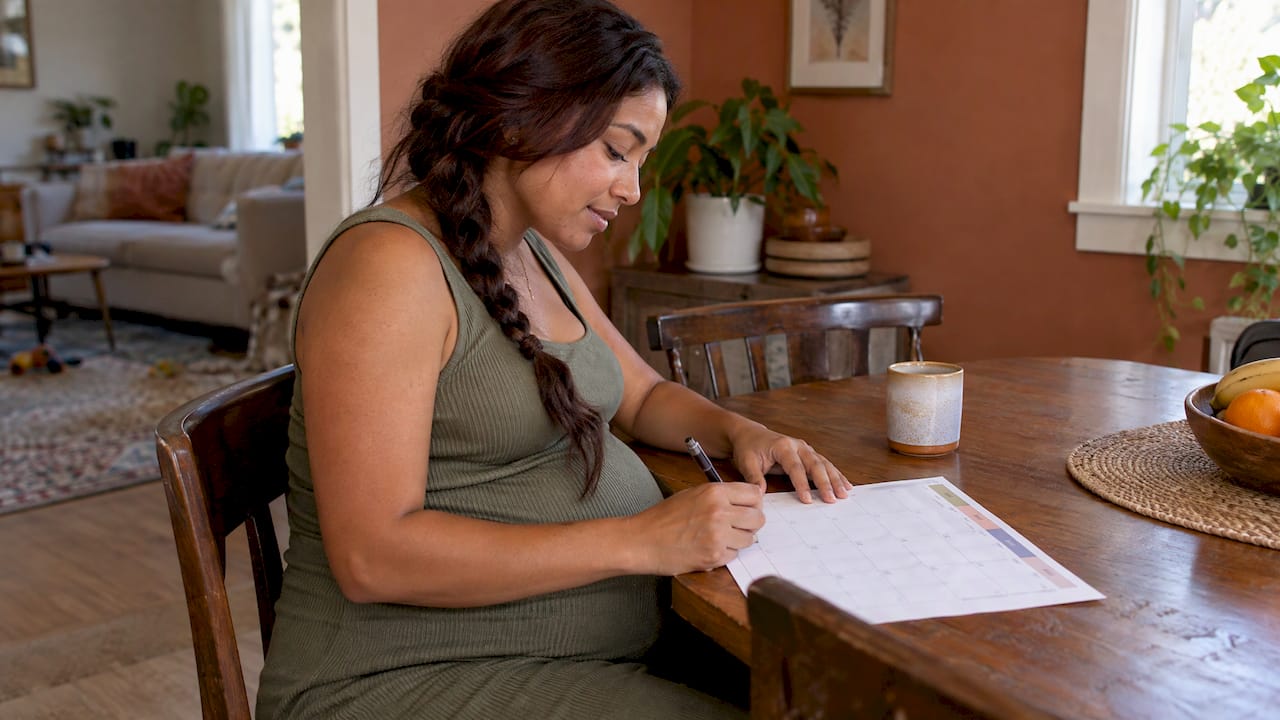
A good printable pregnancy calendar does three things. It counts your weeks the way your care team counts them, it gives you room to write down appointments, symptoms and questions, and it leaves space for the to-dos that pile up before your due date. Below you’ll find how the weeks are counted, what to put on each page, and how to use it between prenatal visits. You’ll also find what changes with twins and when a bound planner is easier than loose sheets.
If you’re newly pregnant and already holding five browser tabs, take a breath. You don’t need a perfect system. You need one place where everything lives.
TL;DR
- Pregnancy weeks are counted from the first day of your last menstrual period (LMP), so “4 weeks pregnant” means the embryo is only about 2 weeks old.
- A useful weekly calendar has a date and week number, an appointment record, a symptom and question log, and a short to-do list.
- Print one page per week or one spread per four weeks, whichever you’ll actually fill in.
- A calendar tracks your pregnancy. It doesn’t replace your provider’s schedule, which can change with your health and risk level.
- Twin pregnancies use the same week counting, but expect a fuller calendar and ask your provider about your own visit schedule.
Table of Contents
- How pregnancy weeks are counted (and why it matters for your calendar)
- What a printable pregnancy calendar should include
- A simple layout you can print today
- How to use your calendar week by week
- Your calendar and your provider’s schedule
- Pregnant with twins: what changes on the calendar
- Printable pages or a planner? Choosing what lasts
- Our Pregnancy Planner
- Common mistakes with pregnancy calendars
- FAQ
- Start with one page this week
- Sources
How pregnancy weeks are counted (and why it matters for your calendar)
Every weekly calendar starts with one question: where does week 1 begin? It begins on the first day of your last menstrual period, not on the day you conceived.
The Merck Manual describes pregnancy as lasting about 40 weeks counted from the LMP, with gestational age given in weeks and sometimes days when more precision is needed. The same page explains that a person who is four weeks pregnant by LMP dating is carrying an embryo about two weeks old.

So to answer the question many first-time moms type into search: no, four weeks pregnant does not mean you conceived four weeks ago. It means four weeks have passed since your LMP began.
A quick way to find your week
- Write down the first day of your last period.
- Count the full weeks from that date to today.
- Add the leftover days. Three weeks and two days is written 3w2d.
- Write that date and week at the top of your calendar’s first page, then fill in each following week.
Your provider may adjust your due date after an early ultrasound. If they do, change your calendar to match theirs. Their dating always wins over a printed chart.
Weeks, months and trimesters
The confusion between weeks and months is real. Forty weeks is a little over nine calendar months, because months are longer than four weeks. That’s why a weekly calendar feels more precise than a monthly one, and why most care teams talk in weeks.
Use trimesters as headers on your pages (first, second, third) and weeks as the real units inside them. Your provider will tell you where they draw those lines for your chart.
What a printable pregnancy calendar should include
Open ten free printables and you’ll see the same problem: pretty layouts, little room to write. Start with function.
An official example helps. The North Carolina Healthy Start Foundation’s My Healthy Pregnancy Calendar includes a prenatal-appointment record with fields for visit date, blood pressure, fundal height (the measurement from the pubic bone to the top of the uterus) and weight. It groups its example visit rows by gestational-week ranges, such as weeks 1 to 4, 5 to 8 and 9 to 12, and tells users to keep their appointments and follow their provider’s advice.
That’s a solid model. Here is what to build around it.
The essential fields
- Week and date range. Start and end dates for each week, plus the week number.
- Appointment record. Date, provider, and room to copy down numbers like blood pressure and weight if your office shares them.
- Symptoms. A few lines or checkboxes for nausea, fatigue, headaches, swelling, sleep, mood.
- Questions for your provider. The list you’d otherwise lose in your head or your phone notes.
- To-dos. Insurance calls, classes, paperwork, registry work.
- Notes. One open box for anything else, from a first kick to a cravings list.
Optional extras that earn their space
- Test and screening dates your provider has ordered
- Medication and prenatal vitamin tracking
- Kick-count notes later in pregnancy, if your provider asks you to track them
- A line for mood and sleep, since both matter and both get forgotten
- A hospital bag checklist you add to as you go
A simple layout you can print today
You don’t need to download a template to start. A sheet of paper and a ruler will do, or you can copy this layout into any document.
| Section | What goes in it | Where it sits |
|---|---|---|
| Header | Week number, dates, trimester | Top of page |
| Appointments | Date, provider, notes, numbers | Left column |
| Symptoms | Daily checkboxes plus a notes line | Center |
| Questions | Open lines, numbered | Right column |
| To-do | 3 to 5 tasks for the week | Bottom |
One page a week or one page a month?
This is the real decision. Here’s how to choose.
| Format | Best for | Watch out for |
|---|---|---|
| One page per week | Detailed symptom logs, people who like writing daily | 40 pages to print and keep together |
| One spread per four weeks | People who want a quick overview | Less room for notes |
| Wall calendar with weeks marked | Seeing appointments at a glance | Nowhere to write symptoms or questions |
Many moms end up using two: a wall or fridge view for dates, and a weekly log for everything else.
How to use your calendar week by week
A calendar only helps if it fits into your life. Try a five-minute routine.
- Sunday reset. Write the new week number and dates. Check which appointments fall in it.
- Add questions as they come up. Don’t wait. The best questions arrive at 2 a.m.
- Log symptoms briefly. A word or a check is enough. You’re looking for patterns, not writing a diary.
- Bring the page to your visit. Copy down anything your provider tells you, including numbers, and cross off questions as they’re answered.
- Pick three to-dos for next week. More than that and the list becomes noise.
What to track in each stage
You don’t need a different system each trimester, but your focus shifts.
- Early weeks: confirming your due date, scheduling your first prenatal visit, noting symptoms and questions about medications and vitamins. If you’re curious about early scans, our guide to the normal fetal heart rate at 6 weeks explains what that first measurement means.
- Middle weeks: keeping track of scans and screenings, and the first real planning. Many parents wonder about the anatomy scan, and our post on whether you can tell the baby’s sex at 13 weeks covers what is and isn’t possible early on.
- Late weeks: birth preferences, hospital bag, car seat, pediatrician choice and routine tests. If your provider mentions a late-pregnancy swab, you can read why group B strep testing happens and add your questions to the page.
Your calendar and your provider’s schedule
A printable calendar is a notebook, not a medical plan. It helps you remember and prepare, and your care team decides what you need and when.
The 2025 ACOG clinical consensus includes a supplemental sample schedule of prenatal services. It notes that the timing of services may vary with clinical needs, and it separates average-risk pregnancies from those with medical conditions or complications. The same schedule says pregnancies with greater-than-average risk may need more intensive follow-up and sometimes subspecialty care, and that it covers routine services, not condition-specific monitoring.
What that means for you:
- Don’t assume the visit dates in a generic printable match yours. Write in the dates your office gives you.
- If your provider adds visits or tests, add them to your calendar and note why, so you can ask follow-up questions.
- If you notice something that worries you, such as bleeding, severe pain, or reduced movement later in pregnancy, call your provider or go to urgent care rather than waiting for the next calendar entry.
Pregnant with twins: what changes on the calendar
If you’re expecting twins, you’re probably searching for a twin pregnancy tracker or checklist. The good news: the week counting is the same. Week 1 still starts at your LMP, and your provider will confirm dating by ultrasound.
What changes is the volume. Expect more to write down, so give yourself more room.
- A bigger appointment record. Your care team may schedule visits differently from a single pregnancy. Ask for your specific schedule and write each date in as it’s set.
- More questions. Add a section for questions about monitoring, delivery planning and what to expect at each scan.
- Double the prep. Registry and nursery to-dos multiply. Make a separate list for items you need two of and items you only need one of.
- A page for each baby’s details. Later, you’ll want a spot for each baby’s measurements from scans, as shared by your provider.
A weekly layout with larger boxes works better for twins than a monthly overview. Use the one-page-per-week format, and leave a wide notes column.
Printable pages or a planner? Choosing what lasts
Loose printables are fine at the start. Then reality sets in: pages go missing, the ink runs low, and half the info lives on your phone.
A few signs a bound planner may suit you better:
- You’ve printed the same calendar three times because pages got lost.
- You want pregnancy, newborn and toddler information in one place, not scattered across sites.
- You’d like to bring one book to every appointment.
- You want something you can keep as a record after the baby arrives.
If you’re still deciding what to buy for the baby, our free tools help too. The hospital bag checklists and the ovulation calculator on our site cost nothing, and you can tuck the checklist printout into any calendar.
Our Pregnancy Planner

The Baby Bare Essentials Pregnancy Planner covers pregnancy through toddlerhood in one place. It includes trimester-by-trimester guidance, baby registry checklists, sleep and feeding guides, emotional bonding, development milestones, baby sign language, solid foods and recipes, first aid and potty training. Our guidance is evidence-based and reviewed against ACOG, NHS and AAP recommendations.
It comes in two forms: a hardcover Physical Planner for $120 (one-off) and a Digital Edition for $25 (one-off). Both are on our planner page.

The physical logs are built for writing down the things you’ll want at appointments, so you aren’t relying on memory or a phone battery. If you want to see what’s inside, start at the planner overview.
Our perspective
We built our planner because we kept hearing the same thing from first-time moms: the information is everywhere, and none of it is in one place. A weekly calendar is the right first step. It gives you structure for the part of pregnancy that is hardest to predict.
What we’ve learned is that calendars work best when they connect. The week you’re in should sit next to your appointment notes, your questions, and your preparation list, and then later next to feeding, sleep and milestones. That is why our planner runs from pregnancy through toddlerhood instead of stopping at the due date.
Our approach is to check guidance against ACOG, NHS and AAP, keep the language plain, and leave plenty of space for your own notes. You know your pregnancy best. We want your planner to make that knowledge easier to use.
Rebeka
Common mistakes with pregnancy calendars
- Counting from conception. If your calendar is off by two weeks, this is usually why. Start from the LMP unless your provider has changed your dating.
- Copying generic visit dates. Use your own provider’s schedule.
- Over-designing. A beautiful template you never open helps no one. Keep the fields few.
- Tracking everything. Log what you’d tell your provider. Skip the rest.
- Forgetting the postpartum. Add a few lines for after the birth: follow-up visits, questions about feeding, and who you’ll call for help.
FAQ
How do I know what week of pregnancy I’m in?
Count the full weeks since the first day of your last menstrual period. Providers use this method, with about 40 weeks from the LMP as the full length. If an early ultrasound changes your due date, use your provider’s dating.
Does 4 weeks pregnant mean I conceived 4 weeks ago?
No. At four weeks by LMP dating, the embryo is about two weeks old, because the count starts before conception. Your calendar’s week numbers will therefore run ahead of the baby’s actual age.
What should a weekly pregnancy tracker include?
At minimum: the week and dates, an appointment record, a symptom log, a list of questions, and to-dos. An official example, the North Carolina Healthy Start calendar, tracks visit date, blood pressure, fundal height and weight.
Can I use the same calendar for twins?
Yes, the week counting is identical. Give yourself more space for appointments and questions, and write in the visit schedule your provider gives you, since prenatal service timing can vary with clinical needs.
Does a calendar replace my prenatal appointments?
No. It helps you prepare for them and remember what was said. Keep every appointment your provider schedules, and call them directly with any concerns.
Start with one page this week
You don’t need 40 pages ready today. Pick your LMP date, fill in this week’s page, and add your next appointment. When you want pregnancy, newborn and toddler guidance in one place, explore the Pregnancy Planner at babybareessentials.com.
Leave a Reply