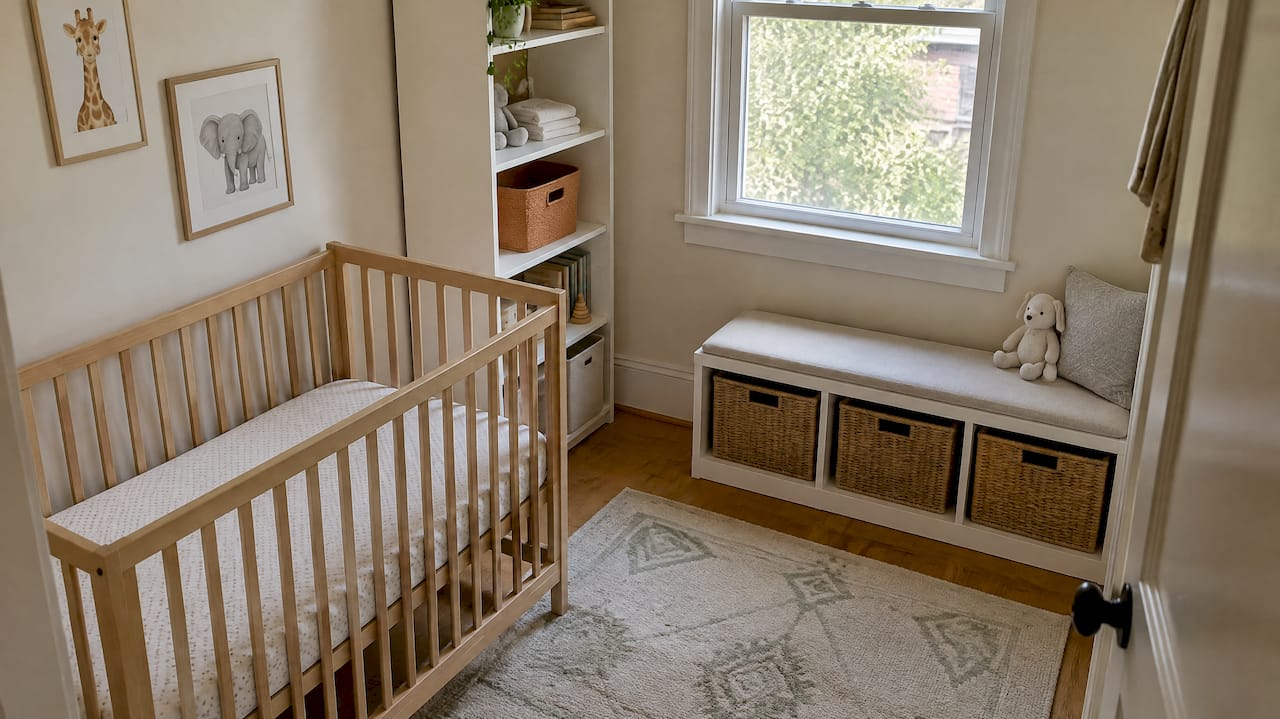
For a small nursery, the fastest safe way to stay organized is a compact, safety-checked sleep surface paired with multifunctional furniture and vertical storage, set up in a single afternoon. The approach has three parts: furniture that does double duty, shelving and hooks that use your walls instead of your floor, and a compact changing station within arm’s reach. Every piece should meet current safe-sleep and anchoring guidance before it earns a spot in the room. Below, you’ll find the exact steps and a quick checklist to make it happen.
TL;DR:
- Adding a second hanging rod or slim shelving can nearly double closet capacity without major renovation.
- Using labeled, file-folded clothes in drawers and under-dresser bins keeps small clothes organized and easily accessible.
- Mounting floating shelves and over-the-door organizers efficiently uses vertical wall space and door surfaces, saving floor area.
- Anchoring dressers and tall furniture with multiple metal anchors is a quick, impactful safety measure to prevent tipping.
- Focusing on multifunctional furniture and consistent small habits, like nightly organization, yields significant space benefits over large overhauls.
Table of Contents
- Three core small-space principles to guide every decision
- High-impact storage solutions for tight nursery footprints
- Clothes organization that keeps a small dresser functional
- Changing station and diapering setup for small rooms
- Closet optimization in a small nursery
- Toy and play storage plus rotation systems
- Safety first: sleep, anchoring, and avoiding recalled items
- A 7-step quick checklist to organize a small nursery in an afternoon
- How our planner supports first-time parents setting up a nursery
- Incorporating portable and foldable items for flexibility
- Utilizing corners and awkward spaces effectively
- Lighting, ambiance, and multifunctional furniture choices
- Author perspective: small habits beat big overhauls
- A planner that keeps the rest of your early parenthood organized
- FAQ
- Sources
Three core small-space principles to guide every decision
Before you buy another bin or shelf, set your rules. These three principles keep you from cluttering a small room with things that seemed useful in the store.
- Declutter first: sort everything into keep, donate, or stash in another room before you organize what’s left.
- Choose multifunctional, safety-certified pieces: a dresser that doubles as a changing station or a crib that converts to a toddler bed earns its footprint twice over.
- Prioritize vertical and near-change storage: shelves, hooks, and wall-mounted bins free up floor space for the things that actually need to sit on the ground, like the crib and a glider.
Apply these rules to every decision, from furniture to the odds and ends gifted at your baby shower. A small nursery doesn’t need less stuff organized well. It needs fewer things, placed with intention.
High-impact storage solutions for tight nursery footprints
Once your decluttering is done, these five solutions do the heaviest lifting in a small room.
- Floating shelves: mount them above outlet height but below your reach limit for one-handed access, and keep heavier books and decor on the lowest shelf.
- Over-the-door organizers: hang one on the closet or nursery door for diapers, wipes, and small grooming items without using any floor space.
- Rolling carts: a slim three-tier cart can hold diapering supplies and roll between the crib and changing area as needed.
- Under-crib or under-bed baskets: choose low-profile bins sized to your crib’s clearance and label them by category, like extra sheets or seasonal clothes.
- Closed bins vs. open baskets: closed bins keep dust and curious little hands out, while open baskets make contents visible at a glance; use closed storage for anything with small parts.
Pairing wall storage with a few well-placed bins typically covers most of what a small nursery needs. Floating shelves and over-door organizers rank among the most commonly recommended small-space tactics in recent home organization guidance, alongside rolling carts and under-crib baskets.
Pro Tip: Measure your crib’s exact clearance before buying under-crib bins. A half-inch too tall and the basket won’t slide free when you need it at 2 a.m.
If you want the shelves to look intentional rather than makeshift, a few framed prints or a simple nursery wall art arrangement above the storage line adds warmth without eating into your square footage.
Clothes organization that keeps a small dresser functional
A small dresser can hold an entire wardrobe if you set it up with a system instead of piling clothes by armful.
- Add width-adjustable dividers to each drawer, two or three per drawer, and group clothing by function: daytime outfits, sleepwear, and onesies.
- File-fold each item so it stands upright in its section, letting you see every piece without digging through the drawer.
- Label drawers by size and keep the current size in the top drawer for the fastest access during diaper changes and outfit swaps.
- Use under-dresser storage for overflow sizes, but keep items in breathable bins rather than sealed plastic to avoid moisture buildup.
- Run a quick “too small, too big” bin workflow each week, moving outgrown pieces into a donation bin and upcoming sizes into a labeled bin near the dresser.
This system takes about twenty minutes to set up and saves far more time every single diaper change afterward.
Changing station and diapering setup for small rooms
Your changing setup doesn’t need a dedicated piece of furniture. A changing pad strapped securely to the top of a sturdy dresser works as well as a slim changing table, and a portable caddy is a smart backup for a second floor of the house.
- Changing pad on dresser: the most compact option, ideal when floor space is the main constraint.
- Slim changing table: better if you want dedicated storage shelves beneath the pad.
- Portable caddy: useful for a living room or grandparent’s house, not a full-time solution.
Keep diapers, wipes, diaper cream, and one change of clothes within arm’s reach of wherever you change your baby, so you’re never stepping away mid-change. Keep the sleep surface itself completely clear of loose items, since the American Academy of Pediatrics recommends a firm, flat sleep surface free of soft bedding and toys.
Pro Tip: Install a dimmable nightlight near the changing station so overnight changes don’t require flipping on a bright overhead light.
Closet optimization in a small nursery
Most nursery closets are built for adult clothing, which wastes vertical space when you’re storing tiny onesies. A second hanging rod installed about a foot below the existing one doubles your hanging capacity instantly.
- Add a second rod or slim shelving to split the closet into two usable zones, hanging clothes up top and bins or cubbies below.
- Use slim, non-slip hangers sized for baby clothes so more items fit per inch of rod space.
- File-fold on shelves the same way you do in drawers, and label every bin by category or size.
- Add a freestanding wardrobe only if the closet is truly too small after these changes, or repurpose a hallway closet for overflow seasonal items.
A well-split closet can realistically double what the space held before, without any construction.
Toy and play storage plus rotation systems
Skip the toy chest with a heavy hinged lid. Low open shelves and labeled baskets let your baby, and later a toddler, see and reach toys independently, and they’re far safer than a lid that can pinch fingers or trap air.
- Use low, open shelving at a height your child can reach once mobile.
- Label baskets by category, like books, stacking toys, or soft toys.
- Rotate monthly, storing out-of-season or less-used toys in a closet bin and swapping them back in to keep play fresh.
- Choose storage that doubles as seating, like a cushioned storage ottoman, when floor space is especially tight.
Rotating toys keeps clutter down and keeps your baby more engaged with what’s out, since only the active set competes for attention.
Safety first: sleep, anchoring, and avoiding recalled items
No organizing system matters if the room isn’t safe. These rules take priority over every storage hack above.
- Use a firm, flat sleep surface. The AAP recommends room-sharing without bed-sharing for at least the first six months, as that period carries the highest SIDS risk.
- Anchor every dresser and tall piece of furniture. Healthychildren with metal anchors, using more anchors on heavier furniture, and keeping the heaviest drawer contents on the bottom.
- Avoid inclined sleepers and loungers for sleep. Healthychildren, favoring a crib, bassinet, or play yard that meets current safety standards.
- Check for recalls before using secondhand gear, especially cribs, bassinets, and any furniture with a drop-side or hinge mechanism.
- Favor washable storage surfaces and keep decorative stuffed animals out of the sleep area to reduce dust and allergy triggers.
A dresser anchored with multiple metal anchors into wall studs is one of the simplest, highest-impact safety steps you can take in a small nursery, according to Healthychildren, and it takes only a few minutes to complete.
A 7-step quick checklist to organize a small nursery in an afternoon
Set a timer and work through these steps in order. Most parents finish in under three hours.
- Declutter the room (30 minutes): sort everything into keep, donate, or relocate piles.
- Anchor the dresser and any tall furniture (15 minutes): this is your non-negotiable safety check.
- Set up the crib with a firm, flat mattress and no loose bedding (10 minutes).
- Install one or two floating shelves (20 minutes): keep heavier items on the lowest shelf.
- Add drawer dividers and file-fold clothes (30 minutes): group by type and label by size.
- Set up the changing station with a caddy of immediate-reach items (15 minutes).
- Build a nightly “basics” caddy (10 minutes): diapers, wipes, and a spare outfit staged for overnight changes.
A printable version of this checklist, along with other nursery prep worksheets, lives inside our Prepare Your Home for Newborn Arrival guide.
How our planner supports first-time parents setting up a nursery
Many planners address the challenge of managing numerous parenting tasks by providing packing lists, room-prep checklists, and trackers that extend beyond the nursery into feeding, sleep, and milestone logs, helping parents maintain organization over time.
For deeper guidance alongside your nursery setup, our newborn essentials shopping checklist and home preparation guide walk through the surrounding tasks, like stocking essentials and prepping the rest of the house, that make the nursery just one piece of a calmer homecoming.
Incorporating portable and foldable items for flexibility
A small nursery benefits enormously from furniture and gear that can change shape or location depending on the moment. A foldable travel crib can serve as backup sleep space during a renovation or a visit to grandparents, then collapse into a closet when not needed. Foldable hampers, collapsible drying racks for bottles, and stackable storage cubes all share the same advantage: they take up real space only when you’re using them.

Portable changing pads with built-in pockets let you move diapering supplies between rooms instead of duplicating stock in multiple locations. A lightweight bassinet on wheels can shift between the nursery and your bedroom during the early room-sharing months recommended by the AAP, without requiring two separate sleep setups.
When shopping for nursery furniture, look for pieces explicitly designed to fold flat or collapse for storage, rather than assuming you’ll make do with permanent pieces. A glider that doesn’t recline as far, or a dresser with removable bins instead of fixed drawers, often adapts better to a room that might need to serve another purpose someday. Flexibility now means fewer replacement purchases later, which matters most in a nursery you might only use for a year or two before converting the space.
Utilizing corners and awkward spaces effectively
Every small nursery has at least one awkward corner, often behind a door or beside a window, that goes unused by default. Corner shelving units, which stack vertically rather than spreading across a wall, make use of that dead space without blocking a doorway or window.
A slim bookshelf angled into a corner can hold board books and a small sound machine, keeping both off the dresser top. Behind-the-door space is prime real estate for an over-the-door organizer or a slim hook rail for robes, swaddle blankets, or a diaper bag. Under windows, a low bench with built-in storage baskets gives you a place to sit during feedings while hiding bulkier items like extra bedding or seasonal clothing.
Even the space behind a glider chair can hold a slim, rolling cart if there’s a few inches of clearance. The goal isn’t to fill every corner; it’s to notice which corners are already wasted and give them one clear job, whether that’s storage, seating, or a reading nook.
Lighting, ambiance, and multifunctional furniture choices
Good lighting does double duty in a small nursery: it needs to support late-night changes without fully waking your baby, and it needs to make a cramped room feel calmer rather than smaller. A dimmable floor lamp or a plug-in nightlight near the changing station lets you see clearly without the jarring brightness of an overhead fixture.

Blackout curtains help naps stick during daylight hours, and a small clip-on lamp near the glider adds reading light without taking up surface space. When choosing furniture, favor pieces that solve two problems at once: a glider with a storage ottoman, a crib that converts to a toddler bed, or a dresser built specifically to double as a changing station. Each multifunctional choice is one less separate piece of furniture competing for floor space, which in a small room is often the difference between cramped and workable.
Author perspective: small habits beat big overhauls
The two changes that make the biggest difference aren’t expensive. A 30-minute declutter session, done honestly, clears more usable space than any organizer you can buy. And a nightly “basics” caddy, restocked before bed, saves more stress than any elaborate system.
Small, consistent habits outlast ambitious one-time overhauls. Start with those two, and the rest of the room tends to fall into place.
— Rebeka
A planner that keeps the rest of your early parenthood organized
Organizing the physical room is one piece of the puzzle. Tracking everything else, feeding windows, sleep stretches, pediatrician questions, tends to live in scattered notes apps and sticky notes unless you have one place for it.

Our Physical Planner and Digital Edition were built for exactly that gap. Inside, you’ll find:
- Printable checklists for nursery setup, hospital bags, and newborn essentials.
- Feeding, sleep, and diaper trackers to log patterns in the early weeks.
- Milestone and development pages to carry you past the nursery stage into toddlerhood.
We built both formats around the same evidence-reviewed approach we use across our blog, so the tracking stays consistent whether you prefer pen and paper or a digital version. The Physical Planner runs $120 and the Digital Edition is $25, both one-time purchases with no subscription. If a dedicated system for the months ahead sounds useful, you can see both options at Babybareessentials.
This article is general information, not a substitute for advice from a qualified doctor. Consult a qualified healthcare professional about your own circumstances before acting on anything here.
FAQ
What are some good ideas for a small nursery space?
Focus on multifunctional furniture, like a dresser that doubles as a changing station, plus vertical storage such as floating shelves and over-door organizers. Keeping the sleep surface clear and anchoring tall furniture matters as much as any storage hack.
How can I organize my small nursery closet?
Add a second hanging rod below the existing one to split the closet into two zones, then use slim hangers and labeled bins on the lower shelves. File-folding clothes on shelves, the same way you would in a drawer, keeps everything visible at a glance.
What are some good ideas for storage in a small nursery?
Floating shelves, rolling carts, under-crib baskets, and over-the-door organizers are widely recommended for small nursery storage because they use wall and under-furniture space rather than the floor. Closed bins work best for small parts, while open baskets suit items you want visible and quick to grab.
What is the best baby organizer for a small space?
There’s no single “best” organizer since needs vary by room layout, but drawer dividers for clothes and an over-door organizer for diapering supplies cover the two highest-traffic categories. Our Physical Planner can help you track which systems you’ve set up and what still needs attention, though it’s a planning tool rather than physical storage.
Sources
- Sleep-Related Infant Deaths: Updated 2022 Recommendations for Reducing Infant Deaths in the Sleep Environment | Pediatrics
- Healthychildren
- Healthychildren
Leave a Reply