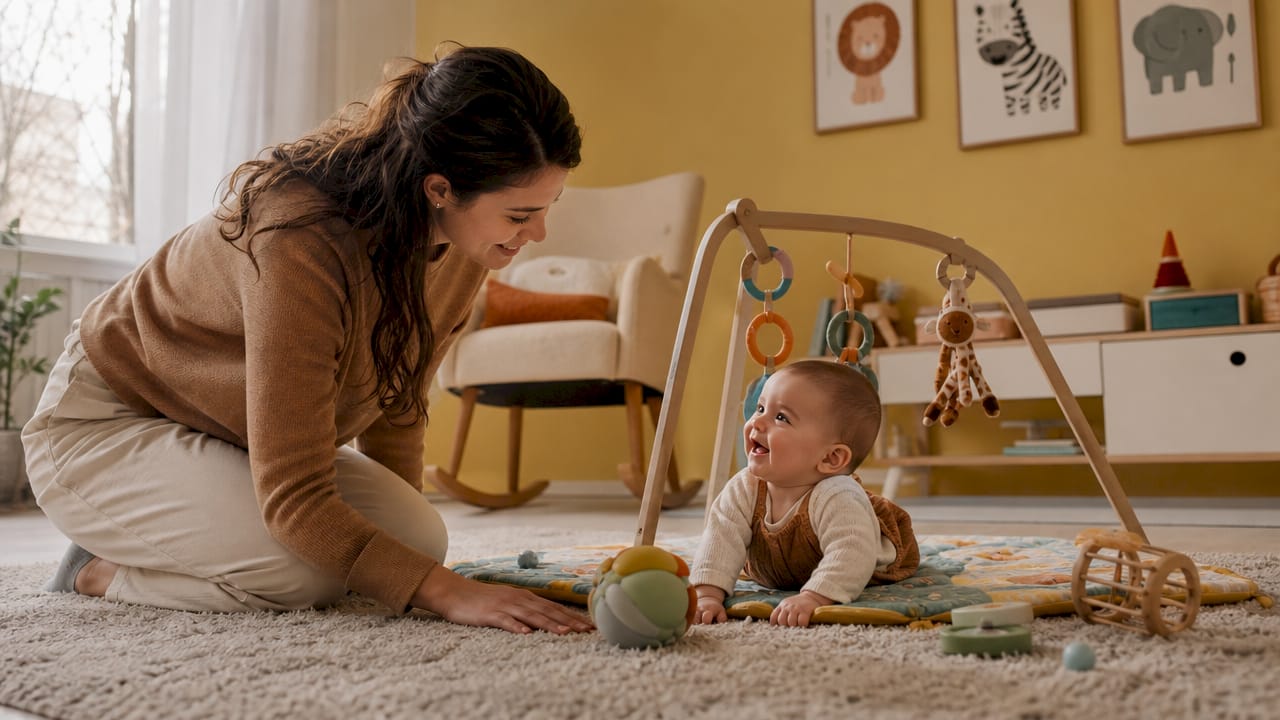
First year baby development stages are defined as the sequence of physical, cognitive, social, and language skills that 75% or more of babies typically reach by specific ages during their first twelve months. The CDC and the American Academy of Pediatrics both use this threshold to set milestone benchmarks, giving you a reliable framework rather than a rigid checklist. Tracking these stages monthly helps you spot patterns, celebrate progress, and catch any concerns early. Think of milestones as a map, not a race. Every baby moves through the same sequence of infant developmental phases, just on their own timeline.
1. First year baby development stages: what they really mean
Developmental milestones are not pass-or-fail tests. They are flexible guides that reflect the range of typical development across thousands of babies. The sequence of skills matters more than hitting an exact date. A baby who sits at 7 months and one who sits at 9 months are both within the normal range.
What you are watching for is forward progress. Each new skill builds directly on the last, so rolling leads to sitting, sitting leads to standing, and standing leads to walking. When you understand this chain, you stop worrying about whether your baby is “on time” and start noticing whether they are moving forward.

The AAP recommends screenings at 9, 18, and 30 months to catch any gaps early. These appointments are your best tool for getting professional eyes on your baby’s progress at the right moments.
2. Physical and motor skill milestones month by month
Motor development follows a head-to-toe pattern. Babies gain control of their head and neck first, then their trunk, then their legs. Here is what to expect across the first year:
| Age Range | Gross Motor Skills | Fine Motor Skills |
|---|---|---|
| 0 to 3 months | Lifts head during tummy time, turns head side to side | Reflexive grasp, hands fisted |
| 4 to 6 months | Rolls front to back, sits with support | Reaches for objects, transfers toys hand to hand |
| 7 to 9 months | Sits without support, begins crawling or scooting | Rakes objects, early pincer grasp |
| 10 to 12 months | Pulls to stand, cruises furniture, may take first steps | Pincer grasp refined, points with index finger |
Some babies skip crawling entirely and move straight to walking. This alone is not a red flag if other skills are progressing steadily. What warrants a call to your pediatrician is the loss of a skill your baby already had, or the absence of head control by 4 months or independent sitting by 9 months.
Pro Tip: Start tummy time from day one, even for just 2 to 3 minutes at a stretch. Daily tummy time builds the neck, shoulder, and core strength that powers every major gross motor milestone in the first year.
3. Cognitive and language development during the first year
Cognitive growth in the first year is faster than at any other point in life. Your baby is building memory, cause-and-effect reasoning, and the foundations of communication all at once.
Key language and cognitive milestones to watch for:
- 0 to 3 months: Startles at sounds, quiets to familiar voices, makes cooing sounds
- 4 to 6 months: Babbling begins with repeated consonant sounds like “ba” and “da,” laughs out loud, tracks moving objects with eyes
- 7 to 9 months: Responds to their own name, imitates sounds, begins to understand the word “no,” explores baby vision development as depth perception matures
- 10 to 12 months: Says first words like “mama” or “dada” with meaning, understands simple commands like “come here,” points to objects of interest
Object permanence, the understanding that things still exist when out of sight, typically develops between 6 and 9 months. This is why peek-a-boo suddenly becomes the most exciting game in the world at that age. It is also why separation anxiety spikes around the same time.
Responsive interactions and early language exposure are the two most powerful tools you have for supporting cognitive growth. Talk to your baby constantly. Narrate your day. Read out loud. The more language your baby hears in context, the faster their own communication skills build. For a deeper look at how this unfolds, the Babybareessentials guide on infant language progression walks through each phase in detail.
4. Social and emotional milestones to watch for
Social and emotional development is often the most overlooked category of baby growth milestones, yet it predicts long-term wellbeing as strongly as motor or language skills.
Watch for these markers across the first year:
- 2 months: Smiles socially in response to your face or voice, not just reflexively
- 3 to 4 months: Makes eye contact consistently, shows excitement by kicking and waving arms
- 5 to 6 months: Recognizes familiar faces, shows clear preference for primary caregivers
- 7 to 9 months: Stranger anxiety appears as your baby becomes aware of unfamiliar people
- 10 to 12 months: Plays simple back-and-forth games like peek-a-boo, waves bye-bye, shows affection by reaching up to be held
Stranger anxiety is a sign of healthy attachment, not a problem to fix. It means your baby has formed a secure bond with you and is now distinguishing between safe and unfamiliar people. This is a developmental win.
To nurture emotional growth, respond consistently to your baby’s cues. When they cry, you respond. When they smile, you smile back. This back-and-forth, sometimes called serve-and-return interaction, builds the neural pathways for emotional regulation that your child will rely on for the rest of their life.
5. How sleep and nutrition support your baby’s development
Sleep and nutrition are not separate from development. They are the fuel that makes every other milestone possible.
Sleep recommendations for the first year
The CDC recommends that 4 to 12-month-old infants get 12 to 16 hours of sleep per 24-hour period, including naps. This is not a suggestion. Sleep is when the brain consolidates new skills and when growth hormone is released. A baby who is consistently under-sleeping will show slower progress across all developmental areas.
Here is a practical sleep framework by age:
- 0 to 3 months: Sleep is unstructured, 14 to 17 hours total, spread across day and night in short cycles
- 4 to 6 months: Two to three naps per day, longer nighttime stretches begin, total sleep around 14 to 16 hours
- 7 to 9 months: Two naps per day, nighttime sleep consolidates to 10 to 12 hours, with some night wakings still normal
- 10 to 12 months: Two naps transitioning toward one, total sleep around 12 to 14 hours
Consistent sleep routines, a predictable sequence of bath, feeding, and quiet time before bed, help your baby’s nervous system shift into sleep mode more easily. Comfortable, well-fitted sleepwear like Minoti cotton sleepsuits can also support better sleep by keeping your baby at a comfortable temperature through the night.
Nutrition and its role in baby growth milestones
Breast milk or formula provides complete nutrition for the first 6 months. Around 6 months, most babies are ready to begin solid foods, and this transition directly supports brain development, iron stores, and the fine motor skills involved in self-feeding. Introducing solids safely means starting with single-ingredient purees, watching for allergic reactions, and following your baby’s hunger and fullness cues rather than a rigid schedule.
Pro Tip: Iron-rich foods like pureed meat, lentils, and iron-fortified cereals should be among the first solids you introduce. Iron deficiency is the most common nutritional gap in infants transitioning to solids, and it directly affects cognitive development.
Key takeaways
Tracking first year baby development stages by sequence, not just by age, is the most reliable way to support your baby’s growth and catch concerns early.
| Point | Details |
|---|---|
| Milestones use a 75% threshold | Skills are benchmarks most babies reach by a certain age, not deadlines every baby must hit exactly. |
| Sequence matters more than timing | Each skill builds on the last; forward progress is the goal, not hitting exact monthly targets. |
| Sleep drives development | Infants aged 4 to 12 months need 12 to 16 hours of sleep daily for brain and physical growth. |
| Responsive parenting accelerates growth | Consistent serve-and-return interactions build cognitive and emotional skills faster than any toy or program. |
| Loss of skills is the real red flag | Regression in any area warrants an immediate call to your pediatrician, regardless of overall timing. |
What I actually tell parents who are worried about milestones
I have seen a lot of first-time parents spiral into anxiety over a single missed checkbox on a milestone chart. And I understand it completely. When you love someone that much, every data point feels urgent.
But here is what I have come to believe after years of working with new parents: the milestone chart is a tool for your pediatrician, not a report card for you. The sequence of developmental skills matters far more than whether your baby rolled at 4 months or 5 months. What you are watching for is steady forward movement, not a perfect score.
The parents I see thriving are not the ones obsessively tracking every week. They are the ones who talk to their babies constantly, get on the floor for tummy time, respond when their baby reaches for them, and show up to their well-child visits. That combination does more for development than any app or chart.
If something genuinely concerns you, trust your instincts and call your pediatrician. You are not being dramatic. Early intervention, when needed, makes a real difference. But most of the time, what your baby needs most is you, present and engaged, not you anxious and Googling at 3am.
— Rebeka
Your next step in supporting your baby’s development
Babybareessentials is built for exactly where you are right now: trying to feel confident and prepared without drowning in conflicting information.

The Baby Bare Essentials covers every stage of the first year, from postpartum self-care for new moms to detailed guides on feeding, sleep, and language development. Whether you are wondering when to introduce solids, how to build a sleep routine, or what your baby’s babbling actually means, you will find clear, evidence-based answers without the overwhelm. Start exploring at Babybareessentials and give yourself the resource you actually deserve.
FAQ
What are the main first year baby development stages?
The first year covers four main areas: physical and motor skills, cognitive and language development, and social and emotional growth. Each area progresses in a predictable sequence, with most benchmarks defined as skills that 75% of babies reach by a certain age.
When should I be concerned about my baby’s milestones?
Contact your pediatrician if your baby loses a skill they previously had, shows no head control by 4 months, or is not sitting independently by 9 months. The AAP recommends formal developmental screenings at 9 and 18 months to catch any gaps early.
How do I track baby development at home?
Keep a simple monthly note of new skills you observe across motor, language, and social categories. Bring this record to every well-child visit so your pediatrician can spot patterns over time rather than relying on a single snapshot.
Do all babies crawl before they walk?
No. Some babies skip crawling entirely and move directly to pulling to stand and walking. This is not a sign of delay as long as other motor and developmental skills are progressing steadily.
How much sleep does a baby need in the first year?
Infants aged 4 to 12 months need 12 to 16 hours of sleep per 24-hour period, including naps. Newborns from 0 to 3 months typically need 14 to 17 hours spread across day and night.
Explore More Pregnancy & Baby Resources
At Baby Bare Essentials, we believe pregnancy should feel more peaceful, informed, and joyful. Explore our most-loved tools and guides:
The Pregnancy Planner
An all-in-one premium planner designed to guide you through pregnancy, birth, postpartum, and your baby’s first years.
Pregnancy Week by Week
Follow your baby’s development and learn what to expect every week of your pregnancy.
Baby Due Date Calculator
Find your estimated due date and understand your pregnancy timeline.
Ovulation Calculator
Track your fertile window and better understand your cycle when trying to conceive.
Hospital Bag Checklist
Everything you need to pack for labor, delivery, and postpartum recovery.
Mom Quiz
Fun and helpful quizzes designed for expecting and new moms.
Real Mom Reviews
Read experiences and feedback from hundreds of mothers who use Baby Bare Essentials.
Pregnancy & Motherhood Blog
Expert-backed articles on pregnancy, newborns, routines, feeding, postpartum, and more.
About the Author
Meet the creator of Baby Bare Essentials and discover the mission behind our brand.
Leave a Reply