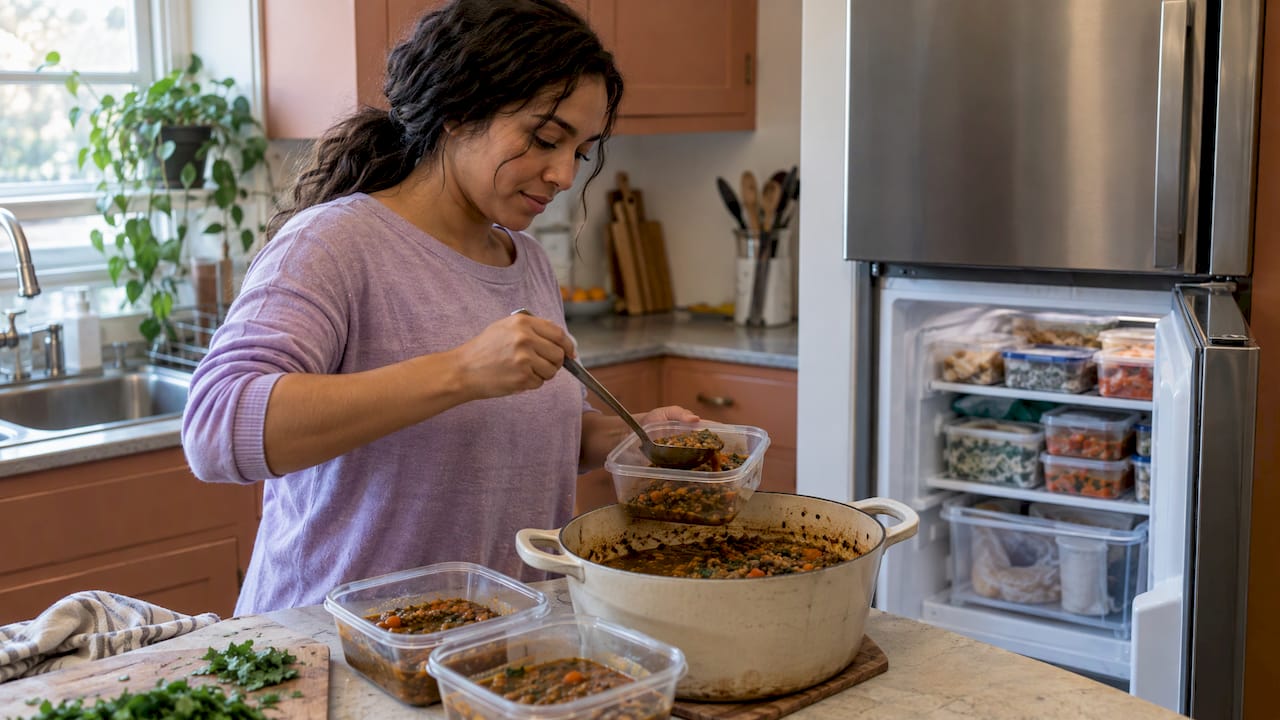
The best postpartum meal prep is small, steady and a little boring: double a few dinners a week in your third trimester, freeze single portions, label them, and fill the gaps with snacks and help from people who love you. You don’t need a perfect month of meals. You need food you can reach with one hand while holding a baby.
This guide walks you through when to start, how many meals to aim for, what freezes well, how to store and reheat it safely, and what your body needs after birth. If you are feeling a little overwhelmed, that is normal. A simple plan makes this one of the easier things on your list.
TL;DR
- Start in the third trimester with extra portions of dinners you already cook, rather than one huge cooking weekend.
- Aim for a freezer stash of dinners, a few breakfasts and plenty of grab-and-eat snacks. Single portions are easiest.
- Freeze at 0°F or below, thaw in the refrigerator, and reheat leftovers to 165°F.
- Breastfeeding raises your energy needs, so include protein, iron-rich foods, whole grains and snacks.
- Label everything and keep a short inventory on the freezer door so anyone can feed you.
Table of Contents
- Why postpartum meal prep is worth it
- When to start postpartum meal prep
- How many meals do you need?
- What to make: meals and snacks that work
- Freezer organization that saves you later
- Food safety: freezing, thawing and reheating
- Nutrition basics for recovery and breastfeeding
- Share the load: help beyond the freezer
- A sample weekend-by-weekend plan
- Promo: keep your prep in one place
- Perspective
- FAQ
- Sources
Why postpartum meal prep is worth it
In the first weeks, you will be feeding a baby around the clock, often on little sleep. Cooking a real meal is the first thing to slip. Skipped meals are common, and your body is recovering from pregnancy and birth while it may also be making milk.
A stocked freezer takes one daily decision off your plate. It also lets your partner, a relative or a friend feed you without asking what to make. Public health nutrition guidance for postpartum women notes that care after birth can overlook the mother’s own nutrition needs, which is exactly why planning ahead matters.
Think of the goal as a reliable food backup, not a flawless schedule. Some weeks your appetite will be huge. Some days you will want something plain. A flexible stash covers both.
When to start postpartum meal prep
The third trimester is the sweet spot. You are far enough along to plan around a due date, and early enough that an early arrival will not catch you with an empty freezer. Many parents begin somewhere between 30 and 34 weeks, but there is no official deadline. Start when your energy and your prenatal care guidance allow.
If you have complications, severe fatigue, nausea or mobility limits, ask your OB or midwife how much standing and lifting is right for you. Then lean more on helpers.
A simple timeline
- Around 30 to 32 weeks: Pick your meal list and check your freezer space. Start the double-dinner method: cook twice the usual amount of a regular dinner, eat half, freeze half.
- Around 34 to 36 weeks: Add one or two longer sessions for freezer-friendly items such as muffins, burritos or soup. Ask a partner or friend to take a specific job, like chopping or labeling.
- Around 37 to 38 weeks: Stop cooking big batches. Do a freezer inventory, stock pantry staples and set up your meal-sharing plan with friends and family.
Spreading the work over several weeks keeps it from becoming one more exhausting project. If you only get a few meals done, that still counts.
How many meals do you need?
There is no required number. A practical target for many households is roughly two weeks of dinners plus a handful of breakfasts and plenty of snacks. Adjust for your household size, freezer space and how much help you expect.
Here is a quick way to size your stash:
- Count the adults who will eat. If you are two adults, one solid meal each per day for 14 days is 28 portions.
- Subtract meals you expect others to bring or deliver.
- Remember that breakfasts, lunches and snacks matter as much as dinners. Lunch is the meal new parents skip most.
- Keep a few emergency staples that need no cooking at all.
By the time your due date arrives, you may find you have fewer frozen meals than planned and more snacks than expected. That is fine. Snacks you can eat one-handed are often what gets used first.
What to make: meals and snacks that work
Choose foods you already like and will look forward to eating. A postpartum freezer is not the place to test a new recipe you are not sure about. Look for meals that reheat well, need only a fork or spoon, and include protein and fiber.
Dinners that freeze and reheat well
A hospital nutrition program lists freezer meals such as bean and cheese burritos, beef and lentil stew, black bean and lentil chili, chicken fajita sheet pan dinner, chicken and wild rice soup, and whole wheat spaghetti with meat sauce. A registered dietitian writing for a parenting outlet adds roasted chicken, meatballs, soups, stews and pasta bakes with extra vegetables.
Good patterns to follow:
- Soups and stews, which reheat evenly
- Pasta bakes and casseroles in small portions
- Meatballs or shredded chicken to add to rice, wraps or salads
- Burritos you can wrap individually and eat with one hand
Breakfasts
Breakfast is easy to forget, and easy to prep. Pancakes, waffles, muffins, breakfast burritos and baked oatmeal all freeze well. Whole grain flour and seeds such as flax, chia or hemp add fiber and staying power, according to the same dietitian’s guide.
Snacks for the nursing chair
Snacks are the unsung heroes. The hospital program suggests banana-oat muffins, lactation cookies and peanut butter granola bars. Other easy options include:
- Smoothie packs you can blend in a minute
- Overnight oats and chia pudding
- Greek yogurt or cottage cheese parfaits
- Hummus with crackers and pre-sliced vegetables
- Hard-boiled eggs, nuts, cheese and fruit
No recipe needs to be fancy. Neutral foods you can combine in different ways give you more flexibility than a rigid menu.
Freezer organization that saves you later
A well-organized freezer means a tired partner or visiting grandparent can find dinner in seconds. Here is a system that works in most kitchens.
- Check your space first. Measure what you really have. If it is small, freeze soups, sauces and stews flat in zip-top bags, then stack them upright like files.
- Freeze mostly single portions. Add a few two-portion packs for days when your partner eats too. Individual servings thaw faster and waste less.
- Label every item. Include what it is, the date you made it, how many portions it holds, and how to thaw and reheat it. Add major allergens and any finishing step, like “add cheese on top.”
- Keep an inventory. A short list on the freezer door or in a shared note lets everyone cross off meals as they go.
- Eat the oldest first. The first in, first out approach keeps quality high. If you plan to freeze breast milk too, leave room for it, and see our guide to breast milk storage and first-in, first-out rotation.
A label might read: “Lentil tomato sauce, one lunch portion, made Oct. 12, thaw in fridge, reheat to 165°F, serve over pasta.” That one line answers every question a helper might ask.
Food safety: freezing, thawing and reheating
This is the part to get right, especially while you are recovering and caring for a newborn. These rules come from federal food safety guidance.
Cooling and freezing
- Refrigerate cooked food within 2 hours, or within 1 hour if it is above 90°F outside. Keep the refrigerator at 40°F or below and the freezer at 0°F or below, per the USDA Food Safety and Inspection Service.
- Cooked meat or poultry leftovers keep 3 to 4 days in the refrigerator. Soups and stews with meat or vegetables keep best for 2 to 3 months in the freezer, and cooked meat or poultry for 2 to 6 months, based on the USDA cold storage chart.
- Frozen storage times are about quality, not safety. According to the FDA’s guidance for pregnant women, freezing keeps food safe indefinitely, but taste and texture decline over time. Meals made in your third trimester will still be good when the baby arrives.
Thawing
Never thaw food on the counter. The FDA lists three safe ways: in the refrigerator, in cold water, or in the microwave. Cook food right away after cold-water or microwave thawing. The easiest habit is moving tomorrow’s dinner from freezer to fridge each night.

Reheating
Reheat leftovers to 165°F, checked with a food thermometer, and bring sauces and gravies to a rolling boil. Cover the food as it heats. These are standard USDA reheating steps. A cheap instant-read thermometer is worth keeping by the stove.
Watch the rice
Cooked rice can carry bacteria whose toxins reheating does not destroy. Cool it quickly, freeze it in small portions, and do not keep it in the fridge more than a couple of days. Pre-cooked rice pouches are a convenient alternative when you need rice with a meal.
Nutrition basics for recovery and breastfeeding
You do not need a special diet. You need enough food, regularly, with a mix of protein, whole grains, fruits, vegetables and healthy fats.
- Energy: State WIC nutrition guidelines say breastfeeding women benefit from about 400 extra calories a day on average, and that women of average weight can eat to hunger rather than count calories. A university nutrition module for health professionals gives about 500 extra calories in the first six months of lactation and 400 after that. Your own needs depend on your body and how much you nurse, so your provider can tailor this.
- Iron: The same university module says iron needs return to pre-pregnancy levels unless blood loss at delivery was higher than typical. If you lost more blood, ask your provider about iron. Pair plant iron sources like beans, leafy greens and fortified cereals with vitamin C foods, which help your body absorb iron.
- Replenishing nutrients: Recovery is also about rebuilding stores of calcium, vitamin B6 and folate, per the University of Washington module. Dairy or fortified alternatives, whole grains and legumes all help.
- Variety: Foods such as oats, nuts, seeds, leafy greens and lean proteins fit easily into freezer meals.
If you follow a restrictive diet or have a medical condition such as gestational diabetes, check your plan with your OB, midwife or a registered dietitian before you stock the freezer. If you want to know how feeding frequency affects supply, our guide on increasing milk supply with 8 to 12 feeds a day explains it.
Share the load: help beyond the freezer
Your freezer is one layer. A second layer is people.
- Pick one coordinator. Ask a friend or relative to organize meals for weeks two through six. Share allergies and preferences with them now.
- Ask for weeks two and three. Help tends to flood in the first week and then disappear just when exhaustion peaks.
- Request lunch and snacks, not only dinner. A snack box with sliced fruit, hard-boiled eggs, nuts, hummus, crackers and cheese is a gift.
- Give your partner a job. On cooking day, one person chops while the other cooks, or one labels while the other bags.
- Stock a pantry. Pasta, canned beans, jarred sauce, frozen vegetables and eggs turn into a meal in 15 minutes.
For more ways to line up support before the baby comes, see our postpartum essentials list and our checklist of must-have items for new moms.
A sample weekend-by-weekend plan
Here is one way to build a stash across a month without burning out. Swap any recipe for one your family likes.
| Week | Focus | What to do |
|---|---|---|
| 1 | Plan | Write a 14-day list of breakfasts, lunches, dinners and snacks. Check freezer space. Buy freezer bags and containers. |
| 2 | Double dinners | Cook double of two weeknight dinners. Freeze half in single portions. |
| 3 | Breakfasts | Bake muffins or make breakfast burritos. Freeze individually. |
| 4 | Soups and sauces | Make one big soup or sauce. Freeze flat in bags. Label with reheating directions. |
| 5 | Snacks and pantry | Prep smoothie packs, energy bites and lactation cookies. Restock pantry staples. |
| 6 | Final check | Update your inventory. Set up your meal-sharing plan and show your partner where everything is. |
If you are already past your due date or the baby has arrived, you can still do small sessions during naps, or ask a partner to batch cook on a weekend.
Promo: keep your prep in one place
Meal prep is one item on a long early-parenthood list. Our Baby Bare Essentials planner brings pregnancy checklists, baby registry planning, feeding and sleep guides, development milestones and more into one place, from pregnancy through toddlerhood. It comes as a hardcover Physical Planner for $120 or a Digital Edition for $25, both one-time purchases. You can explore the planner here.

If you are still building your list, our free hospital bag checklist is a good companion to your freezer plan.
Perspective
We hear the same worry from first-time moms again and again: “I have so many lists, and none of them talk to each other.” Meal prep is a perfect example. It is a small task, but it lives next to the registry, the hospital bag, the pediatrician search and the feeding plan.
Our view is that food is not a side project. It is part of your recovery, and it is part of how you feel in those first foggy weeks. When it is planned, the days feel calmer.
That is why we built our planner to hold the whole early-parenthood picture in one permanent, offline resource, with guidance reviewed against ACOG, NHS and AAP standards. Our approach is to give you clear steps, simple checklists and room to write things down, so you can feel organized and confident instead of overwhelmed.
Start small. Double one dinner this week. You are already doing more than you think.
Rebeka
FAQ
When should I start meal prepping for postpartum?
The third trimester is a good window. Many parents start around 30 to 34 weeks by doubling a few dinners a week, then add one or two longer sessions closer to the due date. Start when your energy and prenatal care guidance allow, and stop if it feels like too much.
Is postpartum meal prep worth it?
For most new parents, yes. Frozen portions mean a real meal is only a thaw and a reheat away, which helps when sleep is short and your hands are full. Even a small stash of a few dinners and snacks takes pressure off the first weeks.
How long do frozen postpartum meals last?
Food kept at 0°F stays safe indefinitely, and the USDA’s storage times describe best quality. According to its chart, soups and stews keep best for 2 to 3 months, and cooked meat or poultry for 2 to 6 months. Label each container with the date and eat the oldest first.
What kinds of meals are best after giving birth?
Choose foods that reheat well and can be eaten with one hand: soups, stews, burritos, pasta bakes, baked oatmeal and muffins. Include protein, whole grains, vegetables and iron-rich foods, plus snacks for nursing sessions. If you have a medical condition or special diet, check with your provider or a registered dietitian.
Sources
- USDA FSIS Kitchen Companion: Your Safe Food Handbook
- USDA cold storage chart (Kitchen Companion, GovInfo)
- FDA: Food Safety for Pregnant Women, Their Unborn Babies, and Young Children
- Arizona WIC Nutrition Care Guidelines: Breastfeeding and Postpartum Women
- University of Washington First Steps Nutrition Modules, Module 5
- Boston Medical Center: Feeding Yourself While Feeding Your Baby
- Motherly: Your Postpartum Meal Prep Guide by a Dietitian
Leave a Reply