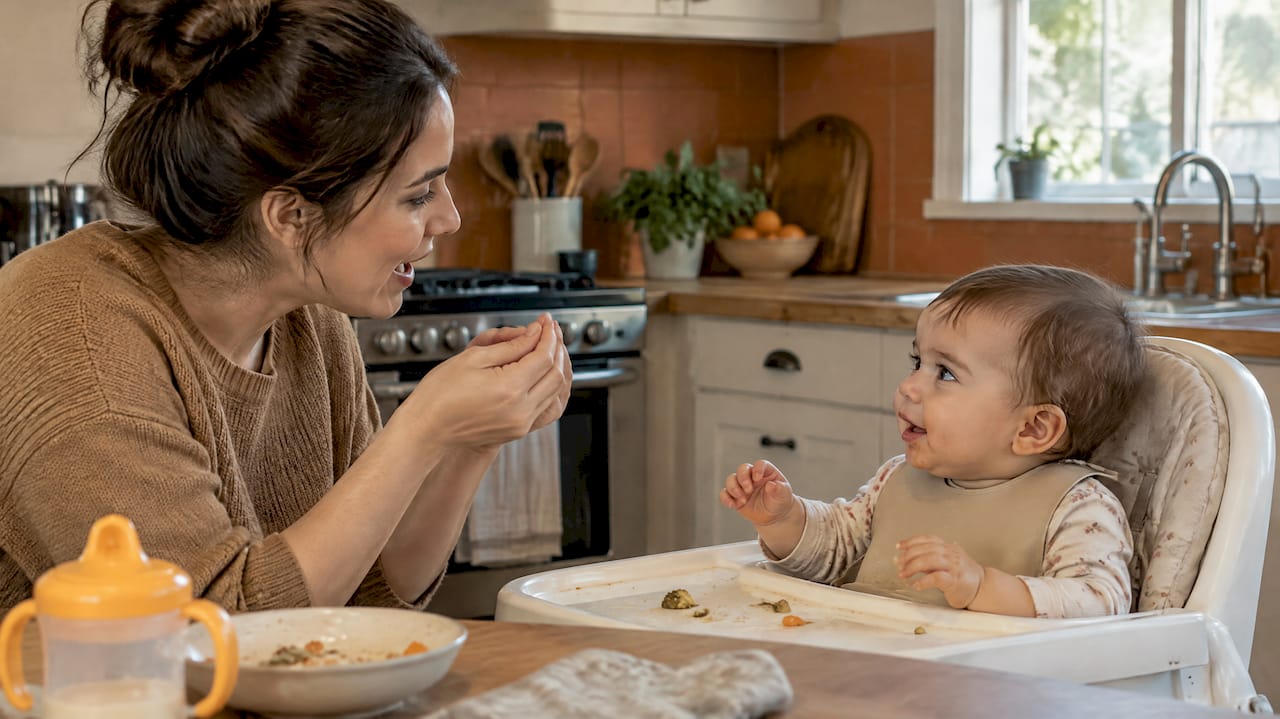
You can start signing with your baby at any age. Most families begin around 6 months, and many babies sign back somewhere around 8 or 9 months. There is no deadline to catch and no need to wait for a perfect moment. If your baby is younger or older than that, you are not early and you are not late.
This guide walks you through what the pediatric experts say about timing, which signs to start with, how to fit signing into the day you already have, and what to expect while you wait for that first tiny “more.”
TL;DR
- Any age is a good age to start. Head Start’s official guidance sets no minimum age for signing with infants and toddlers.
- Many parents begin around 6 months. Babies taught then may start signing back at roughly 8 or 9 months.
- Start with one or two signs tied to routines, such as “more,” “eat” or “all done,” and use them every day.
- Keep talking while you sign. Signing adds to spoken language and never replaces it.
- Research on whether signing speeds up speech is mixed, but it can give your baby an early way to tell you what they need.
Table of Contents
- The Short Answer: Start When You’re Ready
- What Happens at Each Age
- Why 6 Months Is a Popular Starting Point
- Which Signs to Teach First
- How to Teach Signs in Everyday Routines
- How Often to Sign
- Will Signing Affect Your Baby’s Speech?
- Common Mistakes to Skip
- When to Check In With Your Pediatrician
- Our Perspective
- Keep Signs, Milestones and Routines in One Place
- A Simple Plan for This Week
- FAQ
- Sources
The Short Answer: Start When You’re Ready
Parents often hear that you must wait until a baby is a certain age. The guidance from official and pediatric sources says otherwise. Head Start, the federal early childhood program, says any age is a good age to start signing with infants and toddlers, and it does not set a minimum.
The American Academy of Pediatrics (AAP) says the same on its parenting site HealthyChildren.org: there is no need to wait until 6 months to begin modeling signs. That page also notes that babies who are taught at 6 or 7 months may begin communicating with signs as early as 8 or 9 months.
So here is the practical way to think about it:
- Before 6 months: Your baby is not going to sign back yet, but you can show signs while you talk. You are building the habit, and it costs nothing.
- Around 6 to 9 months: This is the popular window. Babies are watching your hands and face closely, and many are starting to copy gestures.
- 9 months and beyond: Still a great time. A baby who is getting frustrated because they cannot tell you what they want often takes to signs quickly.
- Toddlers: Signs can bridge the gap while words are still arriving.
What Happens at Each Age
Babies do not follow a script, so treat this as a loose guide rather than a checklist.
| Age | What you can do | What to expect |
|---|---|---|
| Newborn to 5 months | Sign casually while you talk, feed and change your baby | Your baby watches and listens. No signing back yet. |
| 6 to 7 months | Pick one or two signs and use them at the same moments every day | Your baby is taking it in. Many babies are starting to wave or imitate gestures. |
| 8 to 9 months | Keep going and add a few more signs | Some babies start using basic signs to communicate. |
| 10 to 12 months | Add signs for objects and activities they love | Signs may become more purposeful and frequent. |
| 12 to 24 months | Pair signs with every new word | Spoken words begin to take over. |
The timing in the middle rows comes from the AAP, which describes 8 or 9 months as the age when babies start to know what they want and may use basic signs. The same page says spoken communication usually expands between 18 and 24 months.
If your baby is not signing back at 9 months, that is very common. Some babies take longer, and some skip signing entirely and go straight to words.
Why 6 Months Is a Popular Starting Point
At about 6 months, most babies begin to pay close attention to the people around them. Speech-language pathologist Jessica Galgano, PhD, CCC-SLP, explains that children can learn signs at any age and that 6 to 9 months is typically when they begin imitating sounds and gestures.
There is also a motor-skills reason. Head Start notes that babies’ larger motor skills develop before their speech skills. That means a baby may be able to move their hands to communicate before their mouth can form words.
That is why a baby who cannot say “more” yet may still be able to tell you with their hands.
Which Signs to Teach First
Resist the urge to learn fifty signs at once. One or two is plenty at the start.
Pick signs for things your baby already cares about. That is where the motivation is.
“More” is the classic first sign
The AAP lists “more” as a useful early sign. Susan Silbert, MS, CCC-SLP, a speech-language pathologist at Children’s Hospital Los Angeles, writes that “more” may be the easiest place to start because it helps a child get something they want.
Other good first signs
The same Children’s Hospital Los Angeles article suggests “more,” “all done,” “eat,” “open” and “help.” A health system Q&A from Lehigh Valley Health Network adds “milk,” “all done,” “eat” and “hurt” as possible early signs. Head Start suggests signs for daily routines, including “eat,” “milk,” “sleep” and “play.”
A simple starter list:
- More
- All done
- Eat
- Milk
- Sleep
- Play
- Help
Watch a video or follow a trusted illustrated guide so your handshapes match American Sign Language (ASL). Our step-by-step post on how to teach your baby sign words goes deeper on the signs themselves.
How to Teach Signs in Everyday Routines

You do not need flashcards or a special lesson time. The best moments are the ones that already happen every day.
Step 1: Get your baby’s attention first
ASL is visual, so your baby has to see you. Head Start recommends getting the child’s attention before you sign. You can show or point to an object, gently tap an arm or leg, or wave in their line of sight.
Step 2: Say the word and make the sign together
Speak and sign at the same time, in the real situation. Galgano recommends pairing the sign with the spoken word, repeating them, and responding whenever your child tries to communicate.
At the high chair, say “eat” and sign it as the spoon comes up. At the end of a bottle, say “all done” and sign it.
Step 3: Let the sign get your baby something
Signs stick when they work. Silbert’s example uses bubbles: blow bubbles, pause after they pop, ask “more” while modeling the sign, then blow more bubbles right away. Your baby learns that the sign makes good things happen.
The same idea works with a few puffs of a favorite song, another round of peekaboo, or another bite of a food they enjoy. If your baby is starting solids, our solid food introduction checklist pairs well with “eat,” “more” and “all done.”
Step 4: Celebrate every attempt
Early signs rarely look like the picture. A wobbly fist or an open-close hand may be your baby’s first “more.” Respond right away, say the word, and give them what they asked for.
How Often to Sign
Short and steady beats long and occasional. The AAP advises making signing a daily habit, using the same signs consistently, and signing about routine activities and familiar objects.
A realistic rhythm for a tired new mom:
- Choose one or two signs for the week.
- Use them at every meal, every diaper change or every bedtime, whichever fits your day.
- Add a new sign only after your baby seems to recognize the first.
If you are tracking your baby’s days anyway, a log makes this easy. You can jot down which signs you are using and when your baby first copies one. That small note becomes a nice memory and a useful thing to share at checkups.
Will Signing Affect Your Baby’s Speech?
This is the question many first-time moms worry about, so here is the straight answer.
Signing should never replace talking. HealthyChildren advises that you keep talking as much as you did before and that signing should not take the place of spoken language. Every time you sign, say the word out loud too.
What about speeding up speech? Baylor College of Medicine notes that research is still debated on whether signing helps typically developing babies speak sooner. Some studies suggest an improvement, while others find the effect fades over time. Baylor also says signing can give infants an early way to communicate needs and requests and may reduce frustration.
That last point is the real everyday payoff. A baby who can sign “more” or “all done” has a way to tell you what they want before words arrive. Fewer guessing games can mean calmer meals and a more connected feeling between you and your baby.
For a bigger picture of how babies move from coos to words, see the role of language development in babies and our guide on how to support baby language milestones.

Common Mistakes to Skip
Most signing hiccups come from trying too much too soon. A few to avoid:
- Teaching too many signs at once. Start with one or two.
- Signing without talking. Always say the word as you sign.
- Signing when your baby is not looking. Get their attention first.
- Changing the sign. Use the same handshape each time so it is easy to recognize.
- Giving up too early. Babies need many repeats before they copy a sign. Keep it light and keep going.
- Treating it like a test. Signing is play and connection, not a performance.
When to Check In With Your Pediatrician
Signing is a communication tool, not a way to measure development. If your baby is not responding to sounds, is not babbling or gesturing as expected for their age, or you simply have a feeling something is off, talk with your pediatrician. Hearing and speech concerns are best checked early, and your pediatrician can refer you to a hearing specialist or speech-language pathologist when needed.
Our parent-friendly guides on common toddler language delay signs and how to recognize speech delays can help you know what to bring up at the visit. They are not a substitute for a screening.
Our Perspective
Most of the parents we hear from are not asking whether signing is worth it. They are asking how to fit one more thing into days that already feel full. That is a fair question, and it is why we built signing into the Baby Bare Essentials planner instead of leaving it as a loose idea on a to-do list.
When you are tired, you need the signs, the routines and the milestone notes in one place you can flip open. Our planner covers baby sign language alongside sleep, feeding, solid foods, development milestones and emotional bonding, and our guidance is reviewed against ACOG, NHS and AAP recommendations. That way, you are not piecing together conflicting advice from five different apps at 3am.
The best time to start signing is the week you decide to. Pick a sign, use it daily, and enjoy the moment your baby figures out that their hands can talk.
Rebeka
Keep Signs, Milestones and Routines in One Place
The Baby Bare Essentials planner is a hardcover and digital planner that supports you from pregnancy through toddlerhood. Baby sign language is part of it, along with feeding and sleep guides, solid foods and recipes, development milestones, first aid and potty training.

The Physical Planner is $120 one-off, and the Digital Edition is $25 one-off. Both are available on the Baby Bare Essentials site, and you can read more about what is inside on the planner page. If you are still preparing for your baby’s arrival, our guides on newborn care preparation and preparing your home for a newborn are a good next read.
A Simple Plan for This Week
If you want a no-pressure place to begin, try this:
- Choose “more” or “all done.”
- Use it at the same moment every day, saying the word out loud.
- Get your baby’s attention first, and give them what they asked for when they try.
- Add a second sign in a week or two.
- Enjoy it. There is nothing to pass or fail.
When you are ready to keep signs, milestones and daily routines together, take a look at the planner at babybareessentials.com. You are doing a wonderful job already.
FAQ
Is 4 months too early to start baby sign language?
Not at all. Head Start says any age is a good age to start, and the AAP says you do not need to wait until 6 months to begin modeling signs. At 4 months your baby will not sign back yet, but showing signs while you talk builds the habit for both of you.
When will my baby sign back?
The AAP notes that babies taught at 6 or 7 months may begin communicating with signs as early as 8 or 9 months. Every baby is different, so some take longer. Keep signing daily with the same signs, and respond to every attempt, even a messy one.
What is the first sign to teach a baby?
Many speech-language pathologists suggest “more,” because it helps your baby get something they want. “All done,” “eat” and “milk” are also popular first picks since they fit into daily routines. Start with just one or two.
Will baby sign language delay talking?
Signing should not take the place of talking, so keep speaking as you sign. Research on whether signing makes speech come faster is mixed, but it can give your baby an early way to share needs and may ease frustration. If you are worried about your child’s speech, bring it up with your pediatrician.
Do I need to learn full ASL to use baby signs?
No. You only need a handful of signs to begin, and you can add more as your baby grows. Using signs that match ASL keeps things consistent if you want to learn more later.
Sources
- Teaching American Sign Language to Infants and Toddlers, Head Start
- Baby Sign Language: These Hands Were Made for Talking, HealthyChildren.org (AAP)
- Sign Language: How to Teach Your Baby to Communicate, Open Lines
- Using Signs to Help With Early Language Skills, Children’s Hospital Los Angeles
- Baby Sign Language Q&A, Lehigh Valley Health Network
- Teaching babies sign language, Baylor College of Medicine
Leave a Reply