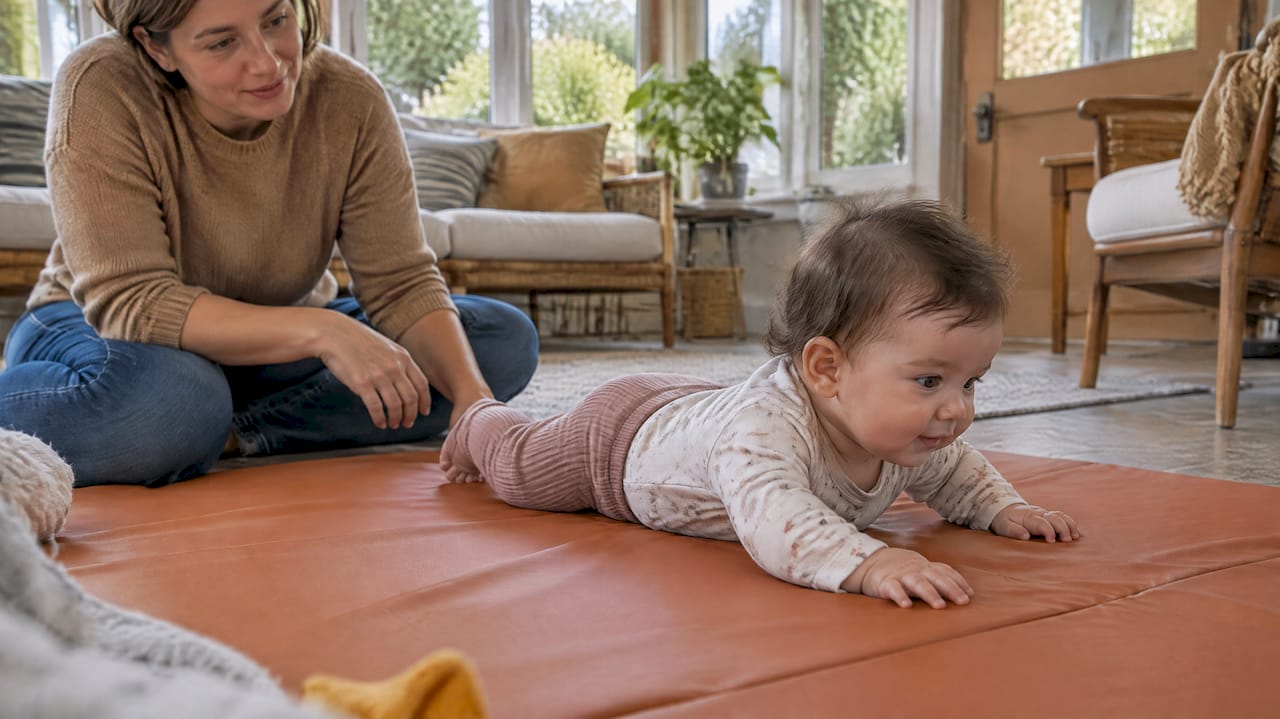
Most babies start rolling between 4 and 6 months, and by 6 months many can roll both ways. If your baby hasn’t yet, you’re not alone in wondering. In many cases a few more weeks of floor play is all it takes. But some signs are worth a call to your pediatrician, and you’ll find them below, along with safe ways to help your baby practice.
We know how this goes. You check the milestone list at 3am, then fall down the search rabbit hole. Let’s slow it down and sort what’s typical from what deserves a conversation.
TL;DR
- Rolling typically appears between 4 and 6 months, often tummy to back first, with both directions common by 6 months.
- Babies develop at different rates, and some take a different route through motor development. Call your pediatrician whenever you have a concern.
- Daily supervised tummy time and plenty of free movement on a firm floor are the best-supported ways to give your baby practice.
- Once your baby shows signs of trying to roll, stop swaddling and keep every sleep on the back.
- Rolling only one way, no attempts by 6 months, stiff or floppy muscles, or a lost skill are reasons to contact your provider.
Table of Contents
- What counts as a typical rolling timeline?
- Is it a delay, or just your baby’s own pace?
- Signs that deserve a call to your pediatrician
- What can affect when a baby rolls?
- Safe ways to help your baby practice rolling
- Safe sleep once your baby starts to roll
- Our perspective
- Keeping track so you can spot the pattern
- One place for milestones, logs and questions
- The short version
- FAQ
- Sources
What counts as a typical rolling timeline?
Rolling is one of the first big movement skills, and it doesn’t arrive on one fixed day. Pathways.org reports that purposeful rolling commonly occurs between 4 and 6 months. Tummy to back often shows up first, and both directions are commonly present by 6 months.
The American Academy of Pediatrics describes the same pattern. Babies begin rolling after the first 3 months, usually front to back before the reverse direction comes later.
Here is a simple way to picture it:
| Stage | What you may see | Typical window |
|---|---|---|
| Push-ups | Baby lifts head and chest during tummy time | Before rolling starts |
| Tummy to back | Baby tips over from tummy, sometimes by accident | Often first, from about 4 months |
| Back to tummy | Baby rocks, reaches and flips on purpose | Usually a bit later |
| Both ways | Baby rolls either direction on purpose | Commonly by 6 months |
For a deeper look at the ages and the evidence, see our rolling over age timeline. If you want the bigger picture of the first year, our first year development stages guide puts rolling alongside the other skills arriving around the same time.
Is it a delay, or just your baby’s own pace?
A few things can be true at once. Babies vary. Some take a different route through motor development. Children’s Hospital of Philadelphia notes that some children skip milestones or take more time, and it advises parents to contact the pediatrician whenever they have developmental concerns.
That last part matters most. You don’t need to prove a problem before you ask. If something feels off, your question is welcome.
Can a baby skip rolling over?
Some babies do move on to sitting, scooting or crawling with little rolling along the way. Because milestones can be skipped, a missing roll alone isn’t automatically a problem. But it is worth mentioning at your next visit, especially if other signs are present. Your pediatrician can look at the whole picture of how your baby moves.
Does your baby’s age need adjusting?
Babies born before 37 weeks may develop later than other children the same age, according to the American Academy of Pediatrics. If your baby arrived early, ask your pediatrician how to read milestones for your baby’s situation. Don’t compare to a calendar based on birth date alone.
Signs that deserve a call to your pediatrician
The AAP lists delayed rolling among the signs of a gross-motor delay. Other signs it names are:
- Poor head and neck control
- Stiff or floppy muscles
- Balance problems
- Losing a skill your baby once had
Pathways.org adds some rolling-specific signals. It recommends contacting your healthcare provider if your baby:
- Has not tried rolling by 6 months
- Shows little interest in reaching or shifting weight
- Can roll only one way
If any of these sound like your baby, call. Don’t wait for the next scheduled checkup. If you have another worry that isn’t on any list, say that too.
What happens at the appointment?
According to HealthyChildren.org, if a concern comes up, your pediatrician may use your observations and a developmental questionnaire, and examine your baby. If a gross-motor delay is found, your baby may be referred to physical therapy or early-intervention services.
A referral isn’t a bad sign. It means your baby gets extra support early, when practice and guidance can help most.
How to prepare for the visit
Bring specifics. “She doesn’t roll” is hard to act on. “She rolls tummy to back but never back to tummy, and she fusses on her belly after one minute” gives your pediatrician something to work with.
Note these things for a week or two before you go:
- Which direction your baby rolls, if either
- How long your baby tolerates tummy time
- Whether your baby reaches for toys and shifts weight
- How head and neck control looks during play
- Any skill your baby used to do and no longer does
- How much of the day your baby spends in a carrier, swing or bouncer
Writing it down as it happens beats trying to remember at the appointment. A log also helps you see slow progress that daily life hides. Our guide on tracking baby milestones in the first year shows a simple way to keep one.
What can affect when a baby rolls?
Timing isn’t only about your baby’s body. Opportunity matters too.
- Early birth. As noted above, babies born before 37 weeks may reach milestones later than peers the same age.
- Time in containers. Connecticut Children’s says extensive time in carriers, swings, bouncers and similar equipment can restrict movement and lead to movement delays.
- Practice time on the floor. The same source frames floor access as something within your control: babies need frequent chances to move freely, and long stretches in restrictive equipment limit practice.
This isn’t about blame. Car seats, strollers and bouncers are part of real life, and sometimes you just need a safe place to set your baby down so you can shower. The goal is simply to make sure the rest of the day has plenty of room to move. Our article on why babies need floor time goes deeper on this.
Safe ways to help your baby practice rolling
You can’t force a roll, and you don’t need fancy gear. What helps is steady, supervised practice. Pathways.org suggests these approaches:
- Daily tummy time. Build it into the routine.
- A toy just out of reach. Baby has to shift weight to get it.
- Supported side-lying. Gets your baby comfortable on the side.
- A gentle assist. Place a hand at the hip to help start the roll.
- Both directions. Practice tummy to back and back to tummy.
Tummy time, step by step
The AAP recommends awake, supervised tummy time starting after your baby comes home from the hospital. Begin with 2 to 3 sessions a day of 3 to 5 minutes, then gradually work toward 15 to 30 minutes a day by about 7 weeks.

If your baby is older and still hates it, keep sessions short and frequent. Lie down face to face. Try a rolled towel under the chest only while you’re watching closely.
The AAP also suggests placing yourself or a toy just out of reach, and arranging toys in a circle around your baby. Reaching in different directions builds the muscles used for rolling. Our tummy time guide walks through starting on day one, safely.
Make the floor your baby’s main play space
Connecticut Children’s recommends maximizing supervised free movement on a firm floor surface. It suggests limiting containers to necessary transport or brief periods when you need a safe holding place.
A simple daily rhythm might look like this:
- A few short tummy time sessions spread across the day
- Floor play on the back, with toys to kick and reach for
- Side-lying play with you beside your baby
- Containers kept for the car, the stroller and short breaks
Keep it calm
Babies learn best when they’re fed, rested and alert. If your baby is crying hard, stop and try again later. Tummy time should never happen when your baby is drowsy or when no one is watching. Sessions are for awake, supervised play only.
Safe sleep once your baby starts to roll
Rolling changes how you think about sleep. Here is what Michigan’s Department of Health and Human Services advises.
- Start every sleep on the back. That stays true at every age.
- Stop swaddling at the first signs of trying to roll. A swaddled baby who rolls onto the stomach may be unable to breathe safely.
- Keep the sleep space bare. Use a firm mattress and fitted sheet, and keep toys, bumpers, loose bedding and other soft objects out.
- Know when repositioning stops. Once your baby can roll independently both ways, back to stomach and stomach to back, you may let your baby stay in the position they move into. You still start each sleep on the back.
If your baby rolls onto the tummy only one way, or you’re unsure whether your baby has truly mastered both directions, ask your pediatrician what to do at night. Our guide to when to stop swaddling covers signs, timing and what to try next.
Our perspective
We hear from first-time parents all the time that the hardest part isn’t the milestone itself. It’s the not knowing. Is this normal? Should I worry? Which website is right?
That’s why we built the Baby Bare Essentials planner as one place for everything. Development milestones, tummy time, sleep guidance and your questions for the pediatrician live together, and our guidance is reviewed against ACOG, NHS and AAP sources.
A physical log matters most in moments like this. When you can flip back and see that your baby was lifting her head at 8 weeks and reaching for toys at 4 months, you walk into the appointment with facts instead of a vague worry. Clear notes help your pediatrician help you.
You know your baby best. Our job is to give you a calm, organized way to use that knowledge.
Rebeka
Keeping track so you can spot the pattern
One slow week rarely tells you much. A pattern over several weeks tells you more. A simple tracker can hold:
- Dates of first push-ups, first rolls and first reaches
- Tummy time length and how your baby reacted
- Questions for the next well visit
- Notes on anything that seems to have stopped
We wrote about why this works in our post on milestone tracker benefits. If you want the broader view, our developmental milestones guide explains what to watch for across ages.
One place for milestones, logs and questions
The Baby Bare Essentials Pregnancy and Parenthood Planner brings milestone guides, tummy time and sleep notes, and space for your pediatrician questions together. It covers pregnancy through toddlerhood, so you aren’t piecing together answers from scattered apps and articles.
The Physical Planner is $120 one-off, and the Digital Edition is $25 one-off. You can see both on the Baby Bare Essentials site.

The planner supports the conversation with your pediatrician. It doesn’t replace it. If you’re worried about rolling, make the call first, and let your notes make the visit easier.
The short version
Rolling usually shows up between 4 and 6 months, but babies take their own routes. Give your baby daily supervised tummy time, lots of floor freedom and toys just out of reach. Switch from swaddling to a bare, back-to-sleep setup as soon as rolling attempts begin. And if your baby rolls only one way, hasn’t tried by 6 months, or shows stiff or floppy muscles or lost skills, call your pediatrician. You don’t have to figure it out alone. When you’re ready, explore the planner at babybareessentials.com.
FAQ
Is it okay if my baby skips rolling over?
Sometimes. Children’s Hospital of Philadelphia says some children skip milestones or take more time. Even so, mention it to your pediatrician, especially if your baby also has poor head control, stiff or floppy muscles or seems to have lost a skill.
When should I worry about my baby not rolling over?
Contact your pediatrician if your baby hasn’t tried rolling by 6 months, shows little interest in reaching, or rolls only one way. Call as well for poor head or neck control, stiff or floppy muscles, balance problems, or a lost skill. Any other worry is also a good reason to call.
What will the pediatrician do if my baby is behind on rolling?
Your pediatrician may ask about what you’ve observed, use a developmental questionnaire and examine your baby. If a gross-motor delay is found, your baby may be referred to physical therapy or early-intervention services.
Should I keep swaddling once my baby starts to roll?
No. Michigan’s Department of Health and Human Services says to stop swaddling once your baby shows signs of trying to roll. A swaddled baby who rolls onto the stomach may not be able to breathe safely. Keep starting every sleep on the back with a bare sleep space.
Does my premature baby roll later?
Possibly. The AAP notes that babies born before 37 weeks may develop later than other children the same age. Ask your pediatrician how to read your baby’s milestones given the early birth.
Sources
- Pathways.org: Rolling
- HealthyChildren.org: How Active is Your Baby?
- Children’s Hospital of Philadelphia: Developmental Milestones
- HealthyChildren.org: Is Your Baby’s Physical Development on Track?
- Connecticut Children’s: Is Your Baby on Track for Motor Milestones?
- HealthyChildren.org: Back to Sleep, Tummy to Play
- Michigan MDHHS: Swaddling and Infant Safe Sleep
- Michigan MDHHS: What should parents do when their baby begins to roll over?
Leave a Reply