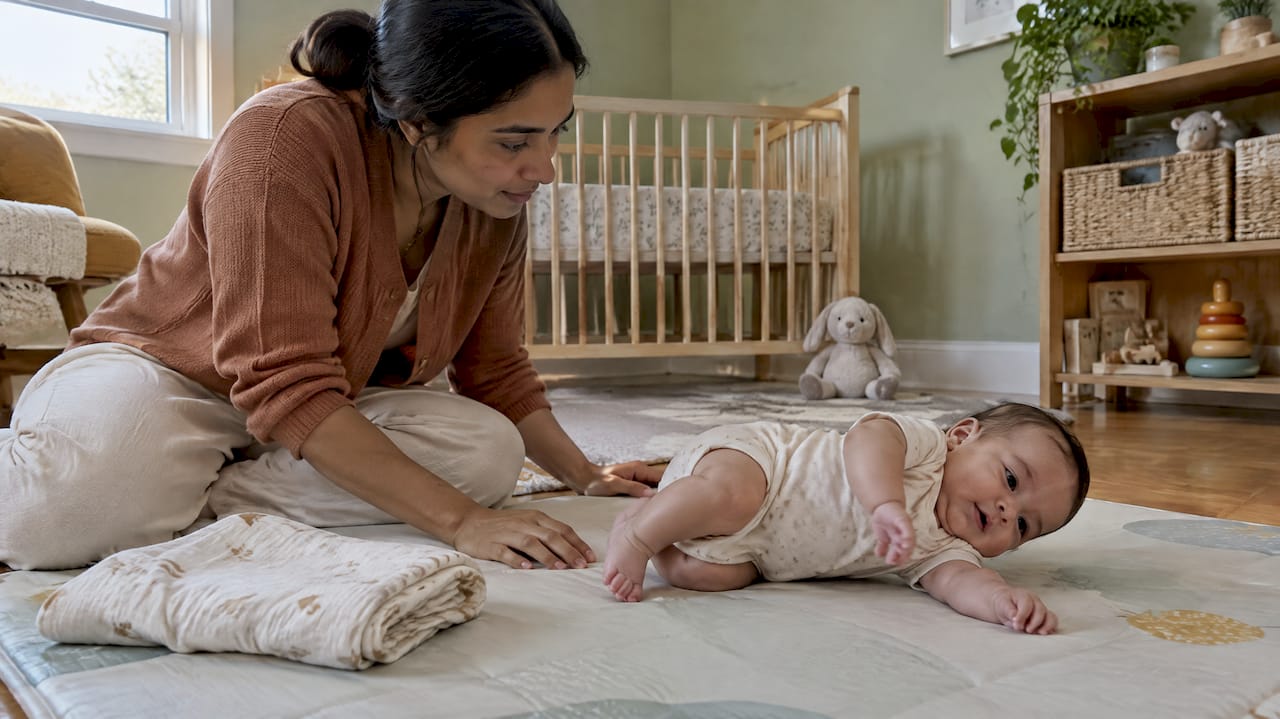
Stop swaddling the moment your baby shows any sign of trying to roll over. For some babies that is as early as 2 months, and for many it is closer to 3 or 4 months. Age is only a rough guide. Rolling signs are the real signal.
If you are reading this at 2am, wondering whether that tiny wiggle counts, you are not alone. This guide walks you through the signs, the safety reasons, three gentle ways to make the change, and what sleep can look like afterward. No fluff, just what you need to decide and act with confidence.
TL;DR
- Stop swaddling as soon as your baby shows any signs of trying to roll, which can happen as early as 2 months, per the American Academy of Pediatrics (AAP).
- Watch for rolling signs, not the calendar: head lifting during tummy time, shifting weight, reaching, and rocking.
- You can go cold turkey or free one arm at a time, then move to an arms-free sleep sack.
- Expect a few unsettled nights. Keep the rest of the routine the same.
- Keep sleeping your baby on their back, on a firm, flat, bare surface.
Table of Contents
- The short answer: rolling matters more than age
- Signs your baby is ready to come out of the swaddle
- Why swaddling has to stop once rolling begins
- Swaddle safely until then
- How to transition out of the swaddle
- Moving to a sleep sack
- What the first nights can look like
- Our perspective
- A simple way to track the transition
- Safe sleep after the swaddle
- What comes next
- A calm way forward
- FAQ
- Sources
The short answer: rolling matters more than age
The AAP says to stop swaddling as soon as your baby shows any signs of trying to roll over, and notes that some babies start working on rolling as early as 2 months old (HealthyChildren.org). The NIH’s Safe to Sleep program gives a similar picture: avoid swaddling once a baby starts to roll over, usually around 3 months.
Here is how the guidance lines up:
| Source | When to stop swaddling |
|---|---|
| AAP (HealthyChildren.org) | At the first signs of trying to roll, sometimes as early as 2 months |
| NIH Safe to Sleep | Once the baby starts to roll, usually around 3 months |
| Oklahoma State Department of Health, citing the AAP | At 3 months or before the baby intentionally starts to roll |
| Mary Bridge Children’s | When the baby shows signs of being ready to roll from back to tummy, typically before 3 to 4 months |
What this means for you: if your baby is 8 weeks old and still not rolling, you do not need to panic, but you do need to start watching closely. If your baby is 6 weeks old and already pushing up and twisting, the swaddle can come off sooner. Your baby’s skills set the timeline.
If you want a closer look at when rolling usually arrives, our rolling over age timeline covers the typical range and what is normal.

Signs your baby is ready to come out of the swaddle
Babies rarely go from perfectly still to a full roll overnight. They practice first. Pathways.org lists these signs that a baby is working toward rolling:
- Lifting their head while lying on their tummy
- Reaching for toys while on their tummy
- Crossing midline with their arms or legs
- Rocking or shifting their weight while on their back, side, or tummy
Other things you may notice in the crib or bassinet:
- Your baby ends up in a different spot or angle than where you laid them down.
- They arch their back and twist their shoulders during the day.
- They wriggle an arm or both out of the swaddle regularly.
One common question: does breaking out of the swaddle mean it is time to stop? Not by itself. A loose swaddle can be a wrapping issue. But a baby who keeps escaping and is also showing the rolling signs above is telling you something. Use the rolling signs as your guide.
Tummy time is the best way to see these skills building, because you are right there to watch. Our tummy time guide shows how to start on day one, safely. Mary Bridge Children’s suggests supervised, awake tummy time from the day you come home, working up to 15 to 30 minutes total each day by seven weeks.
Why swaddling has to stop once rolling begins
The reason is simple and serious. A swaddled baby who rolls onto their stomach cannot use their arms to push up or shift position. The NIH Safe to Sleep program explains that a swaddled baby may have trouble moving out of the stomach or side position, which raises the risk of suffocation and other sleep-related deaths (Safe to Sleep FAQ). HealthyChildren.org also notes that rolling usually happens around 3 to 4 months but can happen earlier, and that the suffocation risk is higher if a baby rolls to their stomach while swaddled.
Two more points that may help you feel settled about the decision:
- Swaddling is a comfort tool, not a SIDS prevention tool. The AAP’s 2022 safe-sleep guidelines, reported by ScienceDaily, state that swaddling has not been shown to reduce the risk of SIDS.
- It does help some babies sleep on their backs. The CDC notes that swaddling is known to calm fussy babies and promote back sleeping, which matters because babies put to sleep on their tummies are twice as likely to die of SIDS.
So swaddling can be a helpful tool in the early weeks. It just has an expiration date, and your baby’s movement sets it.
Swaddle safely until then
While you are still swaddling, how you do it matters. Simple checks:
- Keep the swaddle snug at the chest, loose at the hips. The Michigan Department of Health and Human Services says the swaddle should sit in line with the baby’s shoulders, with room for two fingers between the chest and the swaddle. Hips and legs need room to move to help prevent hip problems.
- Watch for overheating. The CDC advises checking for signs such as sweating or a chest that feels hot to the touch.
- Skip weighted swaddles and weighted blankets. The AAP recommends against them.
- Always place your baby on their back. Every sleep, naps included.
If your baby is swaddled in child care, the AAP covers that too on the same HealthyChildren.org page. Ask your provider about their swaddling and rolling policy so everyone follows the same plan.
How to transition out of the swaddle
There is no single right method. Pick the one that matches your baby’s temperament and your own energy level. Pathways.org says you can transition gradually or all at once, and that starting at night, when your baby is sleepiest, may help.

Option 1: One arm out, then both
This is the gentle path. Swaddle with one arm out for a few nights, then both arms out, before trying a sleep sack. It lets your baby get used to arm freedom in small steps. If you use a swaddle with arms-up or arms-out options, this is easy to do.
Option 2: Cold turkey
Remove the swaddle and move straight to a sleep sack or pajamas. Pathways.org notes you can go straight to a sleep sack if your baby adjusts well to change. Some parents prefer this because it is over faster, even if the first nights are bumpier.
Option 3: A few sleeps at a time
Practice without the swaddle for some naps or one bedtime stretch, and keep it for the rest. Then wean off over a few days to a week or two. This works well if you want to try the change during daytime naps, when you are awake and can watch.
| Method | Best for | What to expect |
|---|---|---|
| One arm out, then both | Sensitive babies, cautious parents | A slower change over several nights |
| Cold turkey | Adaptable babies, parents who want it done | A rougher first few nights, then done |
| A few sleeps at a time | Babies who nap well | A gradual change over days to two weeks |
If your baby is already showing rolling signs, do not stretch the gradual method out too long. Safety comes first, so move on to arms-free sleep once the signs appear.
Moving to a sleep sack
A sleep sack (also called a wearable blanket) is the standard next step. The AAP prefers infant sleep clothing, such as layers or a wearable blanket, over loose blankets to keep a baby warm. It also says sleep sacks that do not swaddle and allow the baby to move freely can be used for as long as you want.
How to pick and use one:
- Check the fit. Pathways.org says a good sleep sack is snug around the armholes and neck, and roomy at the bottom so your baby can bend and kick freely.
- Follow the size guide. Do not size up so your baby can wear it longer. A too-big sack can ride up toward the face.
- Dress for the room. Use layers under the sack to match the room temperature and avoid overheating. Nemours KidsHealth also recommends dressing your baby for room temperature to prevent overheating.
- Keep everything else the same. Same bedtime routine, same room, same white noise. Change one thing at a time.
Need a calm sequence to build around the change? Our baby bedtime routine guide shows what to do at each age.
What the first nights can look like
Be ready for some startle. Without the swaddle, your baby’s arms may fly out, and that can wake them. This is common as babies learn what their arms are doing. Some parents find that a few unsettled nights is a realistic expectation, and many babies settle in within about a week. Every baby is different, so go at your baby’s pace.
What can help:
- Start at night or at the first nap. Pathways.org suggests nighttime, when your baby is already sleepy.
- Use white noise. The CDC notes that white noise, like static, rain, or a small fan, can help babies sleep better.
- Offer a pacifier. The AAP recommends considering a pacifier at nap time and bedtime.
- Soothe with your hands. A steady hand on the chest or a gentle sway before laying your baby down can replace the snug feeling.
- Keep the same sequence. Feed, change, sleep sack, song, down. Repeated cues help your baby know what comes next.
- Offer extra daytime tummy time. Strong arms and shoulders make arm freedom less startling.
If you find yourself rocking or holding your baby for every sleep during this time, you are not doing anything wrong. When you are ready to move past it, our guide to gentle, safe ways to stop contact naps can help.
Sleep can also wobble around 4 months, a time when many babies are changing how they sleep. If that is where you are, read about the 4 month sleep regression so you know what is the swaddle and what is development.
Our perspective
Most of the parents we hear from do not struggle with the idea of stopping the swaddle. They struggle with the timing. Is that wiggle rolling? Is it too soon? Is it too late? And at 3am, the answer is never obvious.
That is why we built our planner around observation, not guesswork. We designed it with physical logs, so you can jot down when your baby first lifts their head, shifts to their side, or escapes a swaddle. Seeing it on paper helps you spot the pattern and share it with your pediatrician at the next visit.
Our guidance is reviewed against ACOG, NHS, and AAP recommendations, and we keep sleep, feeding, tummy time, and milestones in one place so you are not stitching together conflicting advice from ten tabs. We believe a calm, organized parent makes better safety decisions, especially when sleep is short and worry is high.
Our advice on swaddling is the same as the AAP’s: do not wait for a calendar date. Watch your baby, and when the rolling signs appear, make the change.
Rebeka
A simple way to track the transition
A written record takes the guesswork out of this stage. Our Baby Bare Essentials planner includes sleep and feeding guides, development milestones, and logs you can fill in by hand. You can note the first rolling signs, the night you moved to a sleep sack, and how the next several nights went. It comes as a Physical Planner for $120 or a Digital Edition for $25, both one-off prices.

Looking for the full picture of the first year? Explore the planner here, or read more about how the planner works.
Safe sleep after the swaddle
Stopping the swaddle does not change the basics. Keep these in place from now through the first year:
- Back to sleep, every time. The NIH says the best way to reduce SIDS risk is to place your baby on their back for all sleep times.
- Firm, flat, level surface. Use a separate sleep area designed for babies, with no toys, soft objects, comforters, quilts, pillows, or blankets (Safe to Sleep).
- Room-share, do not bed-share. Nemours KidsHealth recommends room-sharing without bed-sharing until the first birthday or at least 6 months. Bed-sharing increases the risk of SIDS and other sleep-related deaths.
- Stay smoke-free. Avoid smoke exposure around your baby.
- Let your baby stay put once they roll on their own. HealthyChildren.org says that if your baby has rolled from back to side or stomach on their own, you can leave them in that position once they can roll both ways, tummy to back and back to tummy. Until then, keep placing them on their back.
If your baby rolls before they can roll both ways, gently turn them onto their back and talk to your pediatrician about what you are seeing.
What comes next
Once the swaddle is gone, sleep keeps changing. Babies drop night feeds, nap patterns shift, and new regressions can appear. Our guides on the dream feed, the 8 month sleep regression, and how toddler sleep needs change can help you plan ahead.
A calm way forward
Watch for rolling signs. Stop swaddling when they appear. Pick the method that suits your baby, move to a sleep sack that fits, and keep the rest of the routine steady. A few rough nights are common, and they pass.
You are doing a great job. If you would like one trusted place to keep your baby’s sleep notes, milestones, and checklists, take a look at the Baby Bare Essentials planner.
FAQ
What age should you stop swaddling?
There is no single age. The AAP says to stop as soon as your baby shows signs of trying to roll, which can be as early as 2 months. Many babies are ready between 2 and 4 months. Watch your baby’s movements rather than counting weeks.
Can I keep swaddling if my baby has not rolled yet?
It depends on the signs. If your baby is showing rolling attempts, such as shifting their weight, rocking, or pushing up in tummy time, stop swaddling even if they have not fully rolled. Ask your pediatrician if you are unsure about what you are seeing.
Should I stop swaddling all at once or gradually?
Both are acceptable. Pathways.org says you can do it gradually, freeing one arm and then both before a sleep sack, or all at once. Choose based on how well your baby handles change, and move quickly if rolling signs are already present.
Is a sleep sack safe for newborns and older babies?
A properly fitted sleep sack that allows free movement is safe, and the AAP says it can be used for as long as you want. Check that it is snug at the neck and armholes, roomy at the bottom, and the right size for your baby. Avoid weighted sleep products.
What if my baby rolls onto their tummy in the sleep sack?
Place your baby on their back to sleep each time. If they can already roll both ways, the AAP says they can stay in the position they chose. If they are still learning to roll, gently return them to their back and mention it to your pediatrician.
Sources
- Swaddling: Is it Safe for Your Baby? (HealthyChildren.org)
- FAQs | Safe to Sleep (NIH)
- Safe Infant Sleep Social Media Live Event (CDC)
- How to Keep Your Sleeping Baby Safe: AAP Policy Explained (HealthyChildren.org)
- 9 Ways to Reduce the Risk of SIDS and Suffocation (HealthyChildren.org)
- MDHHS Infant Safe Sleep: Swaddling
- Safe infant sleep updates for 2022 (Mary Bridge Children’s)
- When to Use Swaddles and Sleep Sacks (Pathways.org)
- Baby Sleep: 8- to 12-Month-Olds (Nemours KidsHealth)
- New safe-sleep guidelines aim to reduce infant deaths (ScienceDaily)
Leave a Reply