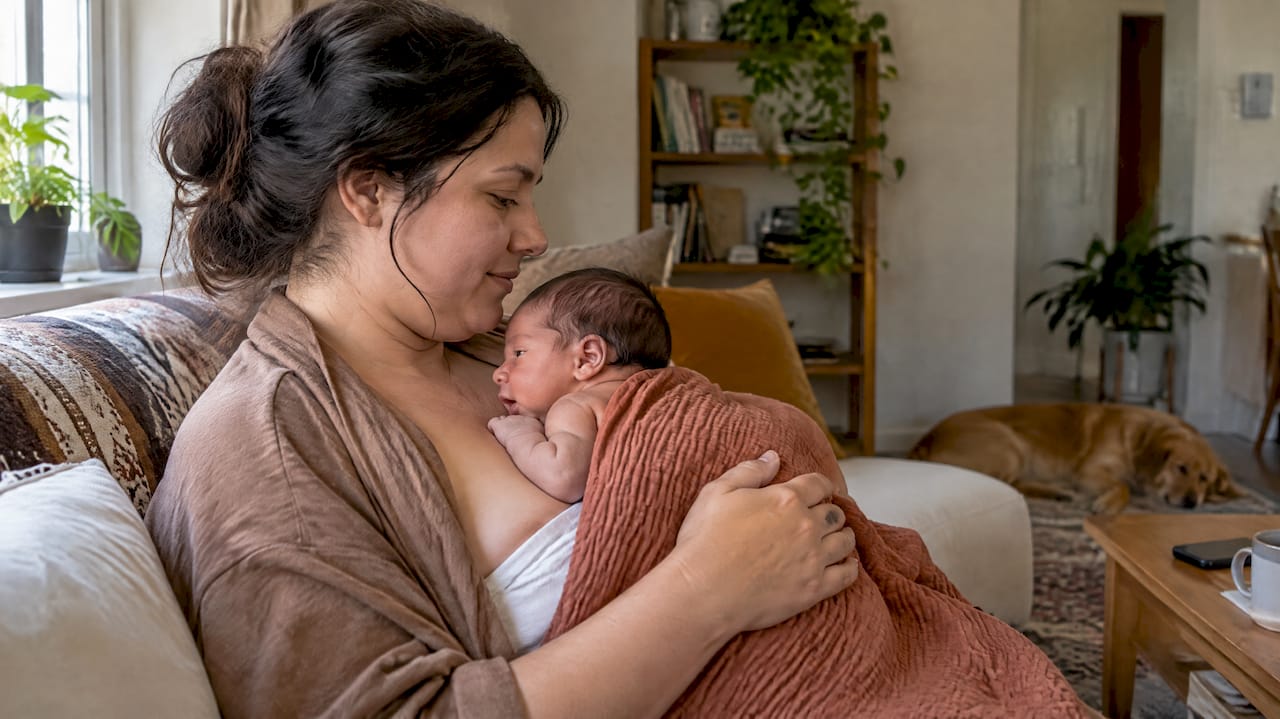
Kangaroo care, or skin-to-skin contact, means holding your diapered newborn upright against your bare chest, and most stable newborns can safely do kangaroo care at home when you follow a few positioning and safety rules. This simple practice supports breastfeeding, helps your baby stay warm, and builds the bond you have been waiting for since the pregnancy test turned positive.
TL;DR:
- For preterm or low birth weight babies, WHO guidance recommends at least 8 hours daily, aiming as close to 24 hours as possible.
- Stable full term newborns can begin within the first hour, while babies needing extra monitoring should wait for their care team’s approval.
- Keep your baby upright, with the head turned, chin lifted, and face uncovered; move them to a crib as soon as you feel sleepy.
- Stop and contact your pediatrician for poor feeding, unusual lethargy, or stalled weight gain, and follow NICU discharge instructions over general advice.
- Aim for sessions of an hour or longer when possible, but 15 to 20 minutes still count, and shorter sessions can build daily totals.
Table of Contents
- What is kangaroo care and who is it for?
- Benefits of kangaroo care for baby and parent
- How to do kangaroo care at home: step-by-step preparation and positioning
- When to start, how often to do it, and when to stop
- Who can provide kangaroo care and how to involve family
- Safety: monitoring, danger signs, and safe-sleep boundaries
- Practical tracking and home routines: keeping a simple KMC log
- What new parents tell us about kangaroo care
- Track your kangaroo care sessions with a tool built for it
- FAQ
- Sources
What is kangaroo care and who is it for?
Kangaroo care began as a way to help preterm and low-birth-weight babies stabilize outside an incubator, and the World Health Organization recommends it as prolonged, continuous skin-to-skin contact rather than a quick cuddle here and there. For full-term, healthy newborns, shorter and more occasional skin-to-skin sessions still offer real benefits, even though the clinical evidence is strongest for preterm infants.
Most parents can start kangaroo care right away, but a few situations call for a chat with your pediatrician first:
- Your baby was born preterm or at a low birth weight and is still being monitored for weight gain
- Your baby has a diagnosed heart, lung, or feeding condition
- You have an uncontrolled medical condition, infection, or are on medication that affects alertness
When in doubt, ask your care team before starting kangaroo care at home. Their answer takes priority over any general guidance here.
Benefits of kangaroo care for baby and parent
Skin-to-skin contact does more than feel nice. It gives your baby’s body and your own stress levels a measurable boost.
- Breastfeeding support: Babies held skin-to-skin show feeding cues sooner, and the CDC lists skin-to-skin contact and rooming-in among evidence-based maternity practices that support breastfeeding initiation.
- Warmth and stability: Hospital guidance from Stanford Medicine describes kangaroo care as helping regulate a baby’s temperature, stabilize blood sugar, and steady heart and breathing patterns.
- Bonding and confidence: The same hospital resources note that parents often report lower stress and greater confidence in their caregiving after regular kangaroo care sessions.
How to do kangaroo care at home: step-by-step preparation and positioning
Getting set up correctly takes just a few minutes, and it makes the whole session safer and more comfortable for both of you.
- Pick your spot. Choose a firm, stable chair with armrests or a semi-reclined position in bed, propped with pillows so you will not slump. Clear the area of loose blankets, cords, and anything that could tip over.
- Set the stage. Put your phone on silent and out of reach. If you feel drowsy at all, ask a partner or family member to sit nearby as a spotter.
- Undress your baby down to a diaper. A hat and socks are fine if the room is cool. You stay bare-chested or wear a loose, open-front shirt.
- Position your baby upright on your chest, between your breasts, with their head turned to one side so the airway stays clear and the chin is lifted off the chest, never tucked down.
- Support your baby with one hand across the back and shoulders, and drape a light blanket over the baby’s back only, never covering the head or face.
- Settle in and stay alert. Sessions of an hour or longer let your baby cycle through deep sleep, which is when many of the physiological benefits happen, but even 20 to 30 minutes is worthwhile when that is all the day allows.
- Watch for feeding cues like rooting or hand-to-mouth movements, and bring your baby to the breast or bottle without breaking skin contact when possible.
A snug, hands-free wrap designed for kangaroo care can free up your arms during longer sessions, but skip rigid commercial positioners or carriers not designed for skin-to-skin use, since they can shift your baby’s airway position without you noticing.
Pro Tip: Start sessions right after a diaper change so you are not interrupted mid-cuddle by a wet surprise.
When to start, how often to do it, and when to stop
Stable, full-term newborns can start skin-to-skin contact within the first hour after birth, and the CDC supports immediate skin-to-skin for medically stable mother-infant pairs. Babies who needed extra monitoring at birth may start later, once your care team gives the go-ahead.
- Aim for multiple sessions a day, building toward at least an hour at a time when your schedule allows
- Shorter 15 to 20 minute sessions still count and add up over a day
- Stop and check in with your pediatrician if your baby shows poor feeding, unusual lethargy, or stalled weight gain
- Follow any NICU discharge instructions exactly, since they may include a specific kangaroo care schedule for your baby’s situation
Who can provide kangaroo care and how to involve family
Kangaroo care is not just a job for mom. Fathers, grandparents, and other steady caregivers can all provide skin-to-skin contact, and involving them spreads out the physical and emotional load of the newborn weeks.
- Practice positioning with your partner before the baby arrives so it feels natural on day one
- Walk backup caregivers through the same checklist: bare chest, diaper only, head turned, chin up, blanket on the back
- Schedule short shifts rather than one long marathon session so no single caregiver gets overtired
- Rotate who handles nighttime sessions to protect everyone’s sleep
Safety: monitoring, danger signs, and safe-sleep boundaries
Kangaroo care is safe when you treat it as an active, awake-parent activity rather than a substitute for crib sleep. The AAP clinical report cautions that caregiver drowsiness during skin-to-skin is a real safety risk, since a sleeping adult can shift position and compromise a baby’s airway without realizing it.
- Move your baby to a separate, firm crib or bassinet with no loose bedding the moment you feel sleepy
- Keep a spotter nearby during longer sessions, especially overnight
- Call your pediatrician right away if your baby feels unusually cold, struggles to breathe, turns pale or bluish, feeds poorly, or seems limp
- For babies who came home from the NICU, follow your discharge team’s specific kangaroo care instructions rather than general guidance
One number worth remembering: the same AAP report ties rare events like sudden unexpected postnatal collapse to caregiver drowsiness during skin-to-skin, which is why the stop-and-transfer rule matters even when a session feels perfectly calm.
Practical tracking and home routines: keeping a simple KMC log
A one-line-per-session log keeps kangaroo care consistent instead of haphazard, and the WHO parent counselling guide includes sample charts for exactly this purpose.
- Jot down start and end times, which side you fed on, and any danger signs you checked for
- Compare daily totals against your target hours so gaps are easy to spot
- Bring the log to follow-up visits so your pediatrician can see the real pattern, not just your memory of it
Many parents prefer a paper system over another app, since there is nothing to charge and no screen glow during a 2 a.m. session, as explained in Newborn Photos at Home: What Kiwi Parents Must Ask. The Baby Bare Essentials planner includes newborn tracking pages that work well for this kind of offline log.
Pro Tip: Keep the log and a pen on the table next to your kangaroo care chair so you write it down the moment the session ends, before the details blur together.

What new parents tell us about kangaroo care
Parents who settle into a regular kangaroo care routine often say the biggest shift is not in the baby but in their own nerves. The first few sessions can feel clumsy, and by the end of the first week most parents describe a noticeable drop in their own anxiety about handling their newborn. One small habit that helps: treat each session as a short, scheduled shift rather than an open-ended cuddle, so you can track it and hand off to a partner without guilt.
— Rebeka
Track your kangaroo care sessions with a tool built for it
We know the newborn weeks blur together fast, and a dedicated place to log kangaroo care hours, feeds, and daily routines takes one more thing off your plate. The Baby Bare Essentials planner gives you offline pages built for exactly this kind of tracking, alongside the rest of your newborn care routines.

See the Physical Planner and Digital Edition at Babybareessentials and find the tracking pages that fit your family’s routine.
This article is general information, not a substitute for advice from a qualified doctor. Consult a qualified healthcare professional about your own circumstances before acting on anything here.

FAQ
What are the disadvantages of kangaroo mother care?
The main risk is not with the practice itself but with caregiver drowsiness, which the AAP links to rare but serious events if a sleepy adult loses safe positioning. Using a spotter and transferring your baby to a crib the moment you feel tired avoids this risk almost entirely.
At what age do you stop kangaroo care?
There is no strict cutoff. The WHO guidance frames kangaroo care as especially valuable for preterm or low-birth-weight babies until they reach a healthier weight or corrected age, while many full-term families simply continue skin-to-skin cuddling as long as it feels natural for both parent and baby.
What is the first color a baby sees?
Newborn vision is blurry and most sensitive to high contrast, so black, white, and strong contrasts are easiest for a baby to notice in the first weeks, with fuller color vision developing gradually over the following months. This is one more reason close-up skin-to-skin time matters, since it keeps your face within your baby’s limited focal range.
Can a father do kangaroo mother care?
Yes, fathers and other steady caregivers can provide kangaroo care using the same positioning: bare chest, diapered baby, head turned with chin lifted, and a light blanket over the back only. Sharing sessions this way helps distribute nighttime duties and lets both parents build the same bond and confidence.
Sources
- Transition to a safe home sleep environment for infants (AAP clinical report)
- Safety in Maternity Care | Breastfeeding | CDC
- Kangaroo Care for Premature Babies in the NICU – Stanford Medicine
Leave a Reply